Data Analyst Salary NYC: What You'll Actually Earn in America's Most Expensive City
Dec 14, 2025

Dec 14, 2025
Look, I've been in the NYC data analyst game for years, and here's what nobody tells you upfront: those salary numbers you see online? They're not lying, but they're not telling the whole story either.
The thing about New York is that everyone wants to be here - the financial giants, the hot startups, the Fortune 500s. That drives up demand for people who can actually make sense of data, which is great for us. But here's the kicker: everything costs more here. Like, a lot more.
I remember when I first moved here from Chicago. Saw a $90K offer and thought I'd hit the jackpot. Then I started apartment hunting. Reality hit hard when I realized that same salary would've gone twice as far back home.
Here's the real deal on current salaries: If you're just starting out, you're looking at $65,000-$85,000. I know, I know - doesn't sound like much for the "greatest city in the world," right? Mid-level folks (that's you after 2-4 years if you play your cards right) can expect $85,000-$120,000. And if you stick around and get really good at this stuff, senior roles pay $120,000-$180,000+.
According to Built In's comprehensive salary survey, the average data analyst salary in New York City is $87,769, with average additional cash compensation of $4,593, bringing total compensation to $92,362 annually. But here's what most salary guides won't tell you - where you work matters. A lot.
Wall Street doesn't mess around. Financial services firms will throw $90,000-$200,000+ at you because when they're moving millions of dollars based on your analysis, they want the best. I've got friends at Goldman who are pulling down serious money, but they're also working 70-hour weeks during earnings season.
Tech companies are right behind them at $80,000-$160,000. Google, Facebook, the fintech startups - they're all fighting for talent. Plus, they usually sweeten the deal with equity and those fancy office perks everyone talks about.
Healthcare and pharma companies sit around $75,000-$140,000. Not as flashy as tech, but the work is meaningful, and you're not going to get laid off when the next recession hits.
Retail and e-commerce? $70,000-$130,000. It's solid work, and honestly, understanding customer behavior is fascinating stuff.
Non-profits and government cap out around $55,000-$95,000. The money's not amazing, but you get actual work-life balance and job security. Sometimes that's worth more than the extra cash. For professionals considering affordable housing options while building their careers, exploring shared apartments in New York can help maximize the value of these competitive salaries.
|
Industry |
Entry-Level Salary |
Mid-Level Salary |
Senior-Level Salary |
Key Benefits |
|
Financial Services |
$90,000-$120,000 |
$120,000-$160,000 |
$160,000-$200,000+ |
High bonuses, stock options |
|
Technology |
$80,000-$110,000 |
$110,000-$140,000 |
$140,000-$160,000+ |
Equity, flexible work |
|
Healthcare/Pharma |
$75,000-$95,000 |
$95,000-$120,000 |
$120,000-$140,000 |
Comprehensive benefits |
|
Retail/E-commerce |
$70,000-$85,000 |
$85,000-$110,000 |
$110,000-$130,000 |
Performance bonuses |
|
Non-profit/Government |
$55,000-$70,000 |
$70,000-$85,000 |
$85,000-$95,000 |
Job security, work-life balance |
That $85,000 salary? After taxes (and NYC loves its taxes), rent, and basic living expenses, you're not exactly living large. A decent one-bedroom in Manhattan will eat up $3,000-$5,000+ of your monthly take-home. Even in the outer boroughs, you're still looking at $2,000-$3,500.
I learned this the hard way. My first apartment was a shoebox in Hell's Kitchen that cost more per month than my parents' mortgage back in Ohio. But you know what? I was in New York, working with some of the smartest people I'd ever met, and every day felt like I was building toward something bigger.
When you factor in NYC's state and city taxes (which can hit 12%+ combined), transportation costs, and general living expenses, your purchasing power often equals what you'd have earning $60,000-$70,000 in cities like Austin or Denver. This is why total compensation packages become crucial. Health benefits worth $15,000-$25,000 annually, retirement contributions, and other perks can make or break a job offer's real value.
Understanding the real cost of living in NYC helps data analysts make informed decisions about salary expectations and housing choices.
Manhattan jobs pay 15-25% more than the same role in Brooklyn or Queens. Sounds great until you factor in the commute costs and the fact that a coffee costs $6 near Wall Street.
A senior data analyst role that pays $140,000 in Manhattan might offer $120,000-$125,000 for the same position in Brooklyn or Queens. The premium reflects both the higher cost of operating in Manhattan and the concentration of high-revenue businesses that can afford top-tier talent.
I've got a friend who turned down a $140K Manhattan gig for a $125K role in DUMBO. She saves an hour of commuting each day, pays $800 less in rent, and actually has a social life. Sometimes the math works out in unexpected ways.
Brooklyn and Queens have emerged as legitimate alternatives, especially with the growth of tech companies in areas like DUMBO and Long Island City. These positions might pay 5-15% less than Manhattan equivalents, but you'll save significantly on commuting costs and potentially enjoy better work-life balance.
Remote work has thrown a wrench into all of this. Some companies now pay 90-95% of NYC salaries for hybrid workers who come in 2-3 days per week, while others maintain full NYC compensation regardless of where you actually live within the metro area. Many data analysts are choosing to live in Brooklyn neighborhoods where they can access competitive salaries while enjoying more affordable housing options and vibrant communities.
Alright, let's talk about what actually gets you paid in this city. I've seen too many analysts spinning their wheels learning every new tool that comes out instead of focusing on what really moves the needle.

Python and R aren't just nice-to-have anymore - they're table stakes. But here's the thing: companies will pay $15,000-$25,000 extra for someone who's actually good with these languages, not just someone who took an online course.
I spent six months really diving deep into Python after work and on weekends. Was it fun? Not really. Did it get me a $20K raise? Absolutely.
SQL is baseline - you won't even get an interview without it. But advanced SQL skills, the kind where you can optimize queries and design efficient databases? That's where you start standing out.
Machine learning is the sexy skill everyone talks about. TensorFlow, PyTorch, scikit-learn - if you can actually build and deploy ML models (not just run them), companies will pay $20,000-$35,000 premiums. But here's my advice: master the basics first. I've interviewed too many people who could talk about neural networks but couldn't clean a messy dataset.
Cloud platform certifications (AWS, Azure, Google Cloud) are huge right now. Pick one and get certified. It's worth $10,000-$20,000 annually, and honestly, it's not that hard if you put in the time.
Data from Built In shows that data analysts with 7+ years of experience earn an average of $120,333, compared to $75,462 for those with less than one year of experience, highlighting the significant impact of skill development over time.
AI-augmented analytics is where the real money is right now. I'm not talking about using ChatGPT to write SQL queries (though that's useful). I mean building workflows that actually leverage AI to solve business problems. People who can do this are getting 20-30% salary bumps.
My colleague Sarah figured this out early. She spent her lunch breaks for three months learning how to integrate GPT APIs into our reporting workflows. Now she's automated half her job and negotiated a senior analyst role with a $25K bump.
Advanced visualization beyond basic Tableau is getting valuable. D3.js, custom Python visualizations, real-time dashboards - these skills can add $8,000-$15,000 to your compensation.
Real-time analytics and streaming data processing skills are becoming increasingly valuable, especially in financial services and e-commerce. Knowledge of tools like Apache Kafka, Spark Streaming, or real-time dashboard development can boost earnings significantly.
Sarah's AI-Powered Career Jump: Sarah, a mid-level analyst at a Manhattan fintech company, invested six months learning AI-augmented analytics tools. She developed automated reporting workflows using Python and ChatGPT API integrations, reducing her team's manual work by 60%. This expertise helped her negotiate a $25,000 salary increase and transition to a senior analyst role at a competing firm.
Master's degrees typically add $10,000-$25,000 to starting salaries, but the ROI depends on where you get it and what you do with it. I've seen people with fancy degrees stuck in junior roles because they couldn't apply what they learned.
The premium is most pronounced at entry level and tends to flatten out as experience becomes more valuable than credentials.
MBAs can boost earnings by $20,000-$40,000, especially if you want to move into strategy or management. But honestly? In most cases, you're better off getting those extra years of experience. However, the ROI depends heavily on the program's prestige and your ability to leverage the network and business acumen gained.
PhD holders often start at higher levels but may face challenges if they're perceived as overqualified for certain analyst positions. The key is positioning advanced research skills as valuable for complex analytical challenges.
According to recent insights from Pace University's business degree analysis, "master's programs in data analytics are among the fields in high demand, with graduates seeing significant salary increases and enhanced leadership skills that employers value most."
Certifications can be worth it if they're directly relevant to your job. Tableau certification at a company that lives in Tableau? Absolutely worth the $5,000-$12,000 bump. Random certification in a tool nobody uses? Waste of time.
Power BI certifications can add $5,000-$12,000 to your salary, especially if the company heavily uses these platforms. The certification demonstrates not just technical competence but also commitment to staying current with industry tools.
SAS certifications still carry weight in certain industries, particularly healthcare and government, where they can add $8,000-$15,000 to compensation. However, their value is declining as open-source tools gain adoption.
Google Analytics and Adobe Analytics certifications are valuable for digital marketing and e-commerce roles, potentially adding $5,000-$10,000 to base salaries in those specific contexts.
The key is picking an industry you're actually interested in and going deep. Don't just learn the tools - understand the business.
Healthcare analytics expertise can command $15,000-$25,000 premiums, especially with knowledge of HIPAA compliance, clinical trial analysis, or pharmaceutical market research. The complexity of healthcare data and regulatory requirements creates high barriers to entry.
Financial modeling and risk analysis skills are particularly valuable in NYC's finance-heavy market. Deep understanding of derivatives, credit risk, or algorithmic trading can add $20,000-$40,000 to compensation at financial services firms.
E-commerce and digital marketing analytics expertise has grown increasingly valuable. Understanding customer lifetime value, attribution modeling , and conversion optimization can boost salaries by $12,000-$25,000 at retail and tech companies.
Skills Development Checklist:
Let me be real with you about how careers actually progress in this city. It's not just about putting in your time - though that matters too.
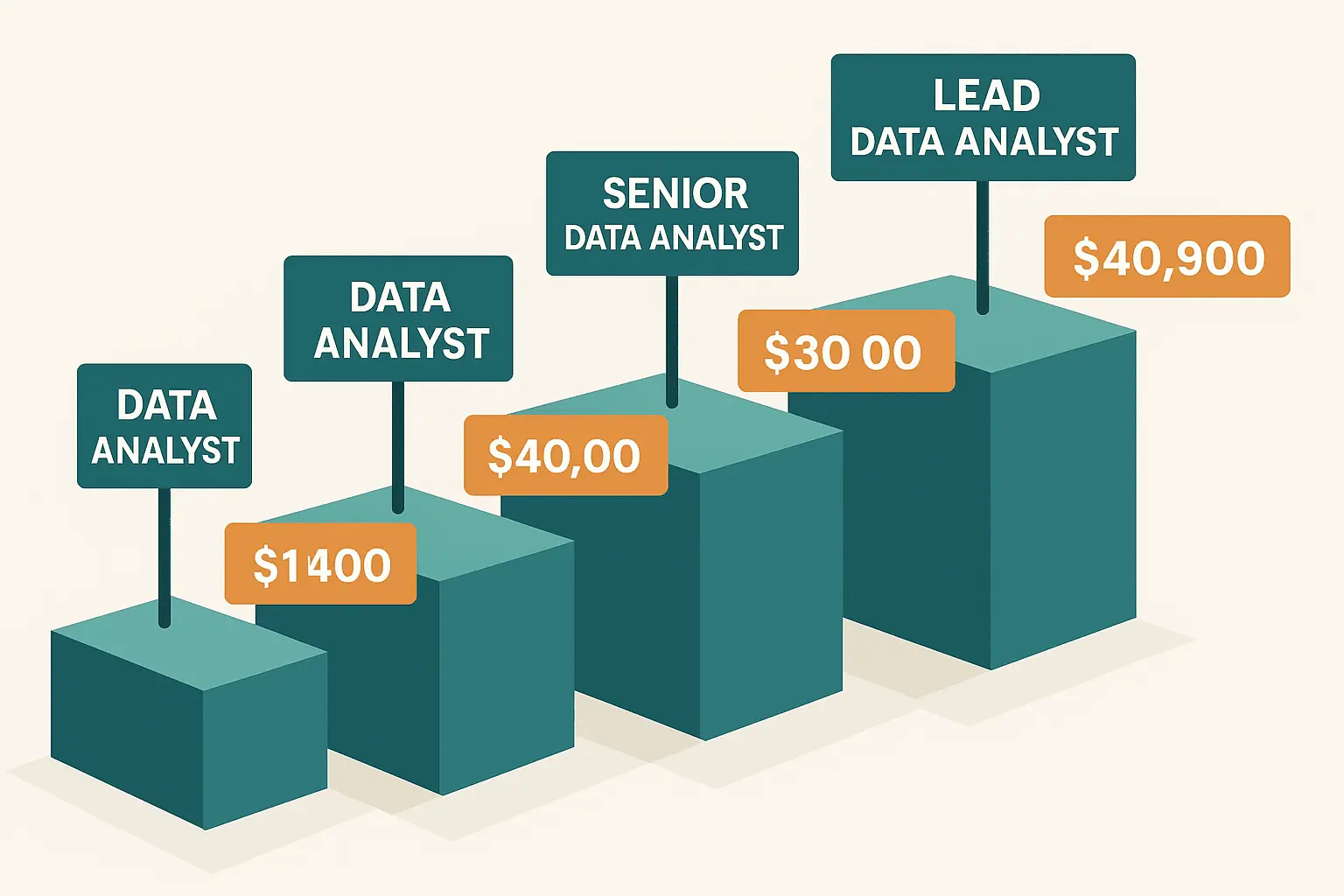
This usually happens around year 2-4, and it's where you see the biggest percentage increase in your career - often 40-60%. You're going from $65,000-$85,000 to $85,000-$120,000, but more importantly, you're finally getting to work on interesting stuff.
The difference isn't just experience - it's mindset. Junior analysts execute tasks. Mid-level analysts identify problems and propose solutions. Can you spot data quality issues before they mess up your analysis? Do you understand why the business cares about the metrics you're calculating?
I made this jump at year 3, but only because I started thinking like a business person, not just a data person. Started asking "why" instead of just "how."
According to Built In's salary data, the most common data analyst salary in New York City falls between $100k - $110k, with people at companies with 201-500 employees earning the highest average of $91,142.
Management roles ($140,000-$200,000+) are a different beast entirely. You'll spend less time analyzing data and more time managing people, budgets, and politics. The compensation jump is significant, but make sure you actually want to be a manager.
I've seen too many great analysts become mediocre managers because they thought it was the only way to advance. There are other paths.
Analytics managers in NYC often oversee teams of 3-8 analysts while serving as the primary interface between technical teams and business stakeholders. Success requires strong communication skills and the ability to translate complex analytical findings into actionable business recommendations.
Director-level positions ($180,000-$300,000+) typically require 10+ years of experience and involve setting analytical strategy for entire organizations. At this level, you're as much a business executive as you are a data professional.
Data engineering is one of the best transitions you can make. Senior data engineers in NYC earn $150,000-$220,000+, and your analyst background gives you something most engineers lack - you understand what makes data actually useful.
My friend Marcus made this transition by spending nights and weekends learning Apache Kafka and cloud infrastructure. Took him eight months of grinding, but he went from $95,000 to $165,000 at a Manhattan hedge fund.
The transition requires developing stronger programming skills (Python, Java, Scala) and understanding distributed systems, cloud architecture, and data pipeline design. However, your analytical background provides valuable context that pure software engineers often lack.
Companies increasingly value data engineers who understand the analytical use cases for the data they're managing. Your experience as an analyst gives you insight into what makes data useful versus just available.
Marcus's Engineering Pivot: Marcus transitioned from a $95,000 senior analyst role to a $165,000 data engineering position at a Manhattan hedge fund. He spent eight months learning Apache Kafka and cloud infrastructure while building internal data pipelines as side projects. His analytical background helped him design systems that actually served business needs, making him invaluable during the transition.
Product analytics is another great path, especially at tech companies where you get equity. These roles pay $130,000-$190,000 and you get to directly impact how products are built.
Business intelligence specialization focuses on building dashboards, reports, and self-service analytics tools for business users. While potentially less exciting than cutting-edge machine learning, BI specialists are essential for organizational decision-making and command solid compensation.
The key to success in either specialization is developing strong business intuition alongside technical skills. Can you identify which metrics actually matter for business success? Do you understand how your analysis influences product decisions or business strategy?

Okay, here's where we get tactical about building a career that actually pays well.
Don't try to learn everything at once. I see people jumping from Python to machine learning to cloud platforms without mastering any of them. Pick one thing, get really good at it, then move to the next.
Start with Python or R - pick one and stick with it until you're genuinely good. Then cloud platforms. Then machine learning. In that order.
Cloud platforms should be your second priority. AWS, Azure, or Google Cloud skills are becoming non-negotiable for mid-level positions. Pick one platform and get certified before expanding to others.
Machine learning comes third, not first. Too many analysts jump straight to ML without solid foundations in data manipulation and statistical analysis. Build your fundamentals, then add the sexy stuff.
For analysts seeking affordable housing while building their skills, consider coliving options in Brooklyn that offer networking opportunities with other tech professionals.
|
Skill Category |
Time Investment |
Salary Impact |
Priority Level |
Key Certifications |
|
Programming (Python/R) |
6-12 months |
$15,000-$25,000 |
High |
Python Institute, R Certification |
|
Cloud Platforms |
3-6 months |
$10,000-$20,000 |
High |
AWS Solutions Architect, Azure Data |
|
Machine Learning |
8-12 months |
$20,000-$35,000 |
Medium |
TensorFlow Developer, AWS ML |
|
Business Intelligence |
3-6 months |
$8,000-$15,000 |
Medium |
Tableau Certified, Power BI |
|
Domain Expertise |
12+ months |
$15,000-$30,000 |
Medium |
Industry-specific certifications |
Business understanding separates good analysts from great ones. Learn how your company makes money. What metrics actually matter? How does your analysis impact decisions? This knowledge can add 15-25% to your compensation.
Financial modeling skills are particularly valuable in NYC's finance-heavy market. Understanding concepts like NPV, IRR, and risk assessment opens doors to higher-paying roles across multiple industries.
Industry expertise takes time but pays dividends. Whether it's understanding healthcare regulations, financial markets, or e-commerce customer behavior, deep domain knowledge commands premium compensation.
Timing matters in NYC negotiations. Q4 and Q1 offer the best opportunities for significant increases as companies finalize budgets and set new year priorities. Avoid major negotiation attempts during Q2 and Q3 unless you have competing offers.
The dense concentration of employers in NYC creates unique leverage opportunities. However, the analytics community is smaller than you'd think – maintain relationships even when declining offers. Today's "no" might become tomorrow's perfect opportunity.
Research total compensation, not just base salary. That $120,000 offer with excellent benefits might beat a $130,000 offer with minimal perks when you calculate the real value.
Use competing offers strategically, not aggressively. Frame discussions around market value and mutual benefit rather than ultimatums. "I've received an offer that values my skills at X level – I'd prefer to stay here if we can find a way to match that valuation."
Don't make up fake offers. This city's analytics community is interconnected, and word gets around. However, actively interviewing and receiving legitimate offers provides real leverage for negotiations.
Consider the full package when evaluating competing offers. Equity, benefits, work-life balance, and growth opportunities often matter more than base salary differences of $5,000-$10,000.
Jennifer's Strategic Negotiation: Jennifer, a senior analyst at a Brooklyn tech company, received competing offers from two Manhattan firms. Instead of using them as ultimatums, she presented market research showing her skills were valued 20% higher than her current compensation. Her employer matched the competing offer's total package, including equity and flexible work arrangements, resulting in a $28,000 increase without changing jobs.
Startups offer lower base salaries ($60,000-$100,000) but equity upside and rapid learning. You'll wear multiple hats, learn quickly, and have direct impact on business outcomes. However, most startups fail, making equity worthless.
Enterprise companies provide higher base compensation ($80,000-$140,000), comprehensive benefits, and structured career paths. You'll have access to cutting-edge tools, formal training programs, and clear advancement opportunities.
Mid-size companies (100-1,000 employees) often offer the best of both worlds – competitive compensation with more autonomy and faster growth than large corporations.
Financial services firms offer the highest total compensation but demand significant sacrifices. Expect 60-80 hour weeks during busy periods, high-stress environments, and intense performance pressure.
Bonus structures can double your total compensation in good years but disappear entirely during market downturns. Base salaries provide stability, but bonuses drive the premium compensation that makes finance attractive.
The regulatory environment in finance creates both opportunities and constraints. Understanding compliance requirements, risk management, and regulatory reporting can make you invaluable but also limits flexibility in analytical approaches.

The market's changing fast, and you need to understand where it's heading.
AI isn't replacing data analysts - it's creating super-analysts who can do 3-5x more work. These people command 20-30% salary premiums and have their pick of opportunities.
The key is learning to work with AI, not being replaced by it. Can you prompt AI tools effectively? Do you know when to trust AI outputs versus when human judgment is essential? Can you validate and interpret AI-generated insights?
Companies are actively seeking analysts who can implement AI solutions for business applications. This isn't about using ChatGPT to write SQL queries – it's about building AI-powered analytical workflows that transform business operations.
Recent market analysis from Nucamp's 2025 NYC Tech Job Report shows that "AI Architects are earning over $200,000 annually" and "Data Scientists are making $120,000-$185,000," with the tech workforce representing 7% of the city's employment and expected growth double that of other sectors.
Specialists in AI implementation are transitioning to roles paying $140,000-$200,000+. These positions require understanding both the technical aspects of AI deployment and the business context for successful implementation.
You'll need skills in model deployment, monitoring, and optimization. How do you ensure AI models continue performing accurately over time? What happens when business conditions change and models need retraining?
The most valuable professionals understand the ethical and regulatory implications of AI in business contexts. Can you identify bias in AI outputs? Do you understand privacy implications of AI-powered analytics?

Hybrid models are settling into 90-95% of full NYC salaries for 2-3 days in office. Fully remote varies by company, but the trend is toward maintaining higher compensation for roles requiring NYC market expertise.
Most companies offer 90-95% of full NYC salaries for employees who maintain 2-3 days per week in-office presence, recognizing both the value of in-person collaboration and the cost savings of reduced office time.
Consider the career implications beyond immediate compensation. Remote workers sometimes miss networking opportunities and mentorship that accelerate growth. Factor these long-term implications into compensation decisions.
For professionals seeking flexible housing arrangements that accommodate hybrid work schedules, furnished rooms for rent provide the convenience and community connections that complement modern work styles.
Healthcare and biotech expansion in NYC is creating premium opportunities for analysts with domain expertise. Roles pay $95,000-$160,000, reflecting the complexity of healthcare data and regulatory requirements.
Personalized medicine, clinical trial optimization, and healthcare cost management are driving demand for analytical expertise. However, you'll need to understand HIPAA compliance, FDA regulations, and the unique challenges of working with patient data.
The aging population and focus on healthcare cost containment create long-term growth opportunities in this sector. Analysts who understand both the technical and regulatory aspects of healthcare analytics are particularly valuable.
Fintech and cryptocurrency companies offer $110,000-$180,000 salaries for analysts comfortable with regulatory uncertainty and rapid industry evolution. These roles require expertise in risk assessment, fraud detection, an d compliance monitoring.
The regulatory environment remains fluid, creating both opportunities and risks. Analysts who can navigate changing compliance requirements while building robust analytical frameworks are particularly valuable.
Traditional financial institutions are also investing heavily in fintech capabilities, creating opportunities for analysts who understand both traditional finance and emerging technologies.

Here's what I wish someone had told me when I started: this career is a marathon, not a sprint. The choices you make about skill development, company selection, and career progression compound over time.
The NYC data analyst market offers substantial earning potential, but success requires more than just technical skills. You need to understand industry dynamics, develop business acumen, and adapt to rapidly changing technology landscapes. The professionals who thrive are those who view their careers strategically, continuously invest in high-value skills, and understand that compensation extends beyond base salary to include benefits, equity, and growth opportunities.
Focus on solving real business problems, not chasing the latest trends. Master fundamentals, understand your industry deeply, and develop communication skills to translate insights into business value. The analysts who command premium compensation are those who become indispensable to their organizations by combining technical excellence with strategic thinking.
For data analysts building their careers in NYC, understanding how much you need to make to live in NYC provides crucial context for salary negotiations and financial planning in this competitive market.
The NYC market rewards excellence, but it also demands continuous learning and adaptation. Invest in yourself, build meaningful relationships, and maintain the curiosity that drew you to this field. With the right approach, you can build both a financially rewarding career and a fulfilling professional life in one of the world's most dynamic cities. The money's here if you're willing to work for it, but remember - in this city, it's not just about what you earn, it's about what you do with it.

Household supplies can be changed or decreaased at Outpost Club’s discretion, or based on supply availability. Outpost is not responsible for temporary losses of utility service. Outpost Club is not responsible for any damages due to absence of any supplies or utilities


If you have a sales related question please call
680-688-7678

 Hot Deals