What I Wish Someone Had Told Me About Manhattan College Costs
Oct 29, 2025
Oct 29, 2025
Let's be honest - college costs are scary. With Manhattan College's comprehensive fee reaching significant levels and tuition having increased 77% over the past decade, according to The Quadrangle, most families I talk to are overwhelmed by the sticker price. But here's what I've learned after helping dozens of families navigate these costs: you have more options than you think.
Understanding how college pricing actually works and knowing when to make your moves can save thousands annually while actually improving your college experience. This isn't about gaming the system - it's about making smart decisions with the information most families never get.
Here's something most people don't realize: Manhattan College uses smart pricing strategies to make their financial aid packages seem more generous than they actually are. Understanding why they set prices this way helps you make better decisions and negotiate more effectively.
When you see Manhattan College's $65,000+ annual cost, your brain automatically treats that as the baseline. It's human nature. But here's what they don't tell you upfront: nearly every private college operates with a 40-50% discount rate through financial aid.
I remember talking to a parent at orientation who was so grateful for their $25,000 "scholarship" that they never questioned whether it was actually a good deal. The truth is, according to PrepScholar data, 91% of Manhattan College students receive some form of financial aid. This isn't unusual generosity - it's how private colleges do business.
Think of it like buying a car. The dealer sets the MSRP high so their "discount" feels like a gift. Colleges do the same thing, just with more paperwork.

Here's something that sounds crazy but it's true: when you have financial conversations with Manhattan College matters more than what you say. I've seen families get completely different responses depending on their timing.
Late February is when they're processing FAFSA forms and starting to see their applicant pool clearly. Mid-April is crunch time - they need commitments and have some room to negotiate. But late June? That's when panic sets in. Enrollment numbers are becoming real, and they'll consider deals they wouldn't touch in March.
One family I know got an extra $5,000 in aid just by calling in July when their son was still deciding between Manhattan College and another school. Same family, same finances, different timing - different result.
Beyond the official tuition, room, and board numbers, there's what I call the "reality tax" - all those extra costs that add up fast but don't appear on the college's cost estimates.
Nobody talks about this, but living expenses in Riverdale run 15-25% higher than national averages. Your transportation costs alone will surprise you. Getting around the Bronx and into Manhattan for internships or social activities adds up fast - we're talking $150-300 monthly just for subway cards and occasional Ubers.
Dining options near campus are limited and expensive. Even basic entertainment costs more because you're essentially paying NYC-adjacent prices without the convenience of actual Manhattan. Budget at least $200-400 extra monthly for these real-world expenses.
Here's something that caught one engineering student's parent completely off guard: specialized software subscriptions that professors "require" can run $500-800 per semester. Professional organization memberships that are "strongly recommended" add another $200-400 annually.
Then there's the networking events, conference attendance, and professional development activities that aren't technically mandatory but are essential if you want to compete for good jobs after graduation. Budget $2,000-4,000 per year for these "optional" expenses that aren't really optional.
|
Hidden Cost Category |
Engineering Majors |
Business Majors |
Liberal Arts Majors |
|
Software Subscriptions |
$1,000-1,600/year |
$400-800/year |
$200-400/year |
|
Professional Memberships |
$300-500/year |
$250-400/year |
$150-300/year |
|
Networking Events |
$800-1,200/year |
$600-1,000/year |
$400-600/year |
|
Conference Attendance |
$500-1,000/year |
$400-800/year |
$200-500/year |
|
Total Hidden Costs |
$2,600-4,300/year |
$1,650-3,000/year |
$950-1,800/year |
This one hits different at Manhattan College. Greek life, campus organizations, and networking events create this constant financial pressure that ranges from $150-500 monthly. You'll feel the pressure to participate because these activities genuinely impact your college experience and job prospects after graduation.
Nobody budgets for the constant stream of dues, fees, social events, and "optional" activities that become essential for fitting in and building the relationships you'll need later.
Manhattan College has incredible connections with engineering firms and financial services companies in NYC, but they don't exactly put up billboards about the sponsorship opportunities.
My neighbor's daughter Sarah discovered through her mechanical engineering professor that ConEd (Consolidated Edison) offered a sponsorship program for Manhattan College students. By applying during her sophomore year, she secured:
The key was building relationships with faculty who had industry connections. These deals exist, but you have to know to look for them and actively pursue them. The career services office has these relationships but won't necessarily bring them to you.
Here's where most families leave serious money on the table. Everyone assumes you need to live on campus or nearby, but strategic housing decisions can dramatically reduce your total costs while actually improving your quality of life and career prospects.
Living in carefully chosen NYC neighborhoods and commuting to the Bronx provides better value and networking opportunities compared to campus housing. I know this sounds backwards, but hear me out.
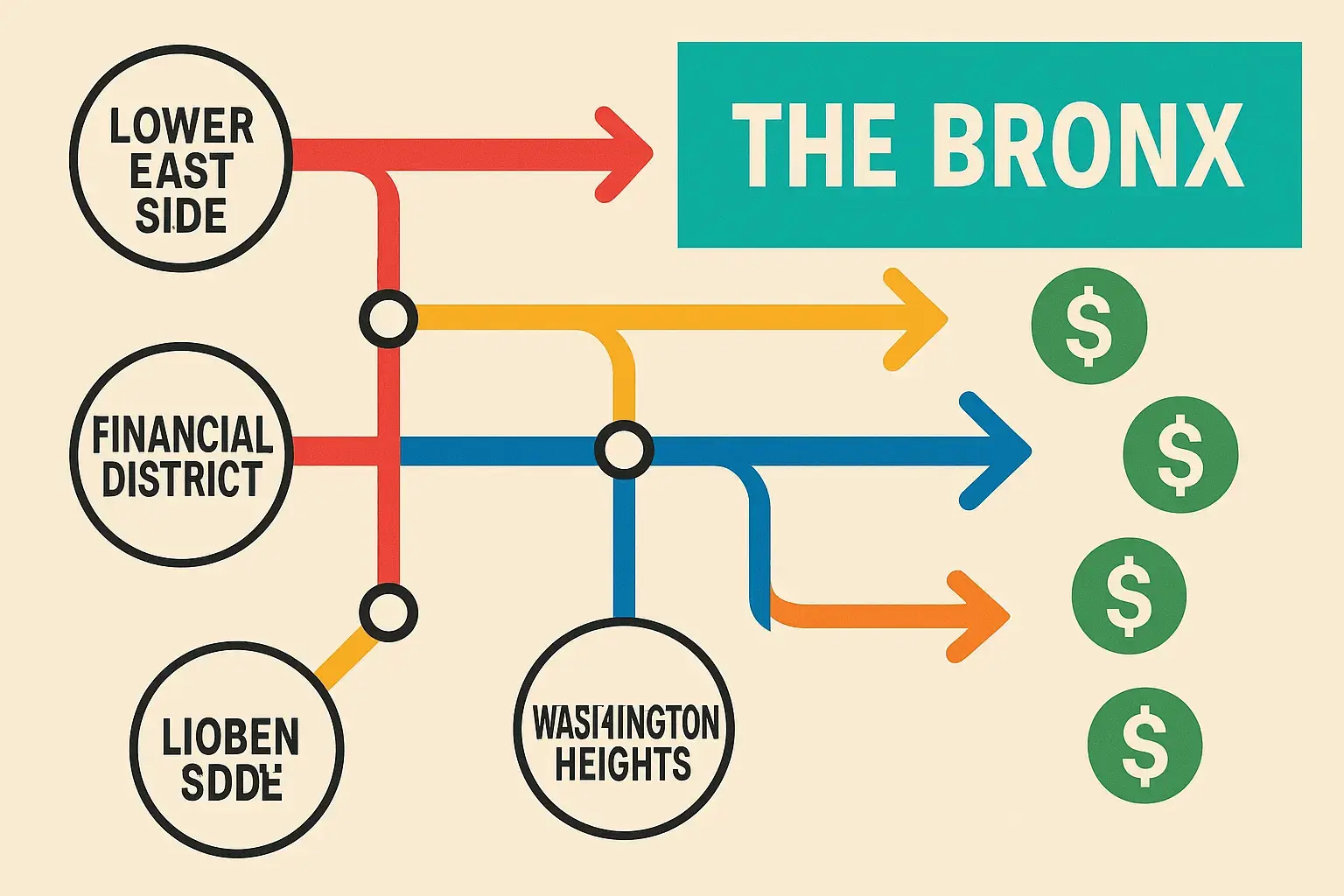
Everyone assumes you need to live on campus or nearby, but Queens changes the entire financial equation. Astoria, Long Island City, and Jackson Heights offer rent savings of $800-1,200 monthly compared to Manhattan College's residence halls.
The commute isn't bad - 35-45 minutes on the subway, which is comparable to what some on-campus students deal with anyway. But you're living in actual NYC neighborhoods with real culture, better food, and networking opportunities that campus housing can't match.
I know students paying $1,400-1,600 for shared apartments in these areas while campus housing runs $2,200-2,800 monthly. That's $9,600-14,400 in annual savings right there.
Here's what surprised me most about students living in Brooklyn: they're not just saving money, they're building better professional networks. You're looking at 40-50% housing cost reductions compared to residence halls, but the real value is living among working professionals instead of just college students.
One student told me the biggest surprise was the mentorship opportunities and job connections he made through his Brooklyn neighbors. These weren't just roommates - they were potential references and industry connections. That kind of networking is impossible in traditional dorms.
Plus, you're building adult living skills and NYC street smarts that will serve you after graduation. Campus housing keeps you in a bubble - Brooklyn throws you into the real world while saving you serious money.
The coliving revolution is perfect for Manhattan College students, but most don't even know it exists. Instead of living with other college students who are just as broke and clueless as you are, you're sharing space with working professionals in finance, tech, and engineering.
Mike, a Manhattan College business student, moved to a coliving space in Crown Heights during his junior year. His results were eye-opening:
These aren't just roommates - they're potential mentors, job references, and industry connections. I've seen students land internships and full-time offers through casual conversations with their coliving housemates.
Let's talk about return on investment, because not all Manhattan College degrees are created equal financially. Your major choice and how you supplement your education will determine whether this investment makes sense for your family.
Engineering programs at Manhattan College are typically money-makers if you play your cards right. We're talking about graduates who can comfortably pay off their loans and build wealth. Liberal arts majors face a tougher calculation, but it's not impossible - you just need to be more strategic.
Engineering graduates entering NYC markets can expect 25-40% salary premiums over national averages. That premium alone can justify Manhattan College's costs, but here's the catch - you need to secure employment within the tri-state area within 18 months of graduation or that advantage starts disappearing fast.
Recent recognition supports this value. Money Magazine ranked Manhattan College in their 2024 "Best Colleges for Your Money" list, with the rankings based on quality of education, affordability, and outcomes focused on earnings ten years after college entry, earning four out of five stars.
The key is leveraging Manhattan College's industry connections during your junior and senior years. Don't wait until graduation to start networking - the engineering firms they partner with recruit directly from campus if you're strategic about it.

Liberal arts majors face a tougher ROI calculation, but I've seen it work when students are strategic about building marketable skills alongside their degree.
The key is developing hybrid skill sets that command premium salaries. English majors who learn digital marketing, philosophy majors who understand data analysis, history majors who can navigate social media strategy - these combinations create unique value in NYC's job market.
Manhattan College's liberal arts programs give you the critical thinking foundation, but you need to add technical skills through bootcamps, certifications, or internships to make the financial math work.
Manhattan College's location gives you access to some of the best tech bootcamps and fintech training programs in the country. Students who add coding skills or fintech expertise to their degrees are commanding starting salaries $8,000-15,000 higher than their peers.
The strategy is using your summers and winter breaks to complete intensive programs while maintaining your Manhattan College enrollment. You graduate with both the degree and the technical skills that employers actually want.
I've seen business majors who completed fintech bootcamps land analyst positions at $75,000-85,000 starting salaries instead of the typical $55,000-65,000 range. That premium pays for the bootcamp costs within the first year.
|
Major + Skill Combination |
Base Starting Salary |
With Additional Skills |
Salary Premium |
ROI Timeline |
|
Engineering + Python/AI |
$65,000 |
$78,000-85,000 |
$13,000-20,000 |
6-12 months |
|
Business + Data Analytics |
$55,000 |
$68,000-75,000 |
$13,000-20,000 |
8-14 months |
|
Liberal Arts + Digital Marketing |
$42,000 |
$55,000-62,000 |
$13,000-20,000 |
12-18 months |
|
Any Major + Coding Bootcamp |
Variable |
+$8,000-15,000 |
$8,000-15,000 |
6-24 months |
The financial aid process at Manhattan College has more flexibility than they let on, but you need to understand how to work within the system. I've seen families unlock thousands in additional aid by knowing when and how to ask.
Manhattan College's financial aid appeals process can result in additional aid packages of $5,000-12,000 annually when done properly. The key is understanding that this isn't about asking nicely - it's about strategic presentation and timing.

Competing offers need to be from comparable institutions - Fordham, St. John's, Pace - and presented professionally. Don't just forward emails. Create a clean comparison document that highlights the financial differences and submit it 2-3 weeks before enrollment deadlines when they have maximum motivation to negotiate.
The key is framing it as a preference for Manhattan College that's being complicated by financial realities, not as a threat to go elsewhere. One family I worked with got an additional $5,000 annually using this approach.
Financial Aid Appeals Checklist:
Changes in family financial circumstances can trigger additional aid adjustments, but most families don't know these opportunities exist. Job loss, medical expenses, divorce, or other financial disruptions can result in additional aid if you document them properly.
The window is tight - 30-60 days from the qualifying event to submit documentation for current academic year consideration. But I've seen families receive $3,000-8,000 in additional aid through these adjustments.
The financial aid office won't proactively tell you about these opportunities. You need to understand the system and advocate for yourself when circumstances change.
Merit aid renewal at Manhattan College depends on specific GPA thresholds - typically 3.0-3.5 depending on your award level. Understanding these requirements allows for smart course planning.
Take challenging courses when you're fresh and motivated, save easier electives for semesters when you're dealing with internships or job searches. Plan your academic schedule around maintaining the GPA requirements that keep your funding intact.
I've seen students lose $8,000-12,000 in annual merit aid because they didn't understand the renewal requirements. Don't make that mistake.
Based on PrepScholar data, the average grant award at Manhattan College is $18,884, which is $2,396 higher than the average for private not-for-profit schools, making merit aid preservation crucial for maintaining affordability.
Manhattan College's willingness to negotiate fluctuates based on enrollment patterns and budget pressures. Understanding these timing windows can unlock significant additional funding opportunities that most families never know exist.
Between May and August, enrolled students change their minds, transfer elsewhere, or face financial crises that force them to withdraw. This creates what I call the "summer melt" - and it's when Manhattan College gets nervous about their numbers.

I've seen students receive calls in July offering additional grants worth $3,000-8,000 just to secure their enrollment. The college would rather discount tuition than deal with empty seats and budget shortfalls.
If you're on the waitlist or considering Manhattan College late in the process, this is your window. They'll make deals in August that they'd never consider in February. One student I know was offered an extra $6,000 in aid during a phone call in late July - same student, same finances, just different timing.
Students transferring to Manhattan College in January often receive more favorable financial packages. The college knows exactly where they stand financially by January, and they're motivated to fill any enrollment gaps.
Transfer students represent additional tuition revenue they weren't counting on in their original budget projections. If you're considering transferring to Manhattan College, January entry gives you negotiating leverage that fall applicants don't have.
Many families confuse Manhattan College with other Manhattan-based institutions, but you can use this confusion strategically in negotiations.
Financial aid offers from NYU, Columbia, or Fordham carry serious weight in negotiations with Manhattan College, even if the programs aren't directly comparable. Regional competition matters more than program similarity in financial aid offices.
Negotiation Success Story: Jessica's Strategic Leverage
Jessica received offers from both Manhattan College and Fordham University. Her approach:
Here's something that might surprise you - Manhattan College's costs can actually become competitive with SUNY schools when you run the real numbers. Their higher aid distribution rates and better graduation timelines change the total cost calculation.
SUNY schools look cheaper on paper, but Manhattan College's smaller class sizes and better support systems often lead to four-year graduation rates that SUNY can't match. An extra year or two at a "cheaper" school ends up costing more than four years at Manhattan College with proper financial aid.
Manhattan College offers multiple payment structures that can be optimized for tax benefits and cash flow management through strategic timing.
Timing your 529 plan withdrawals to align with Manhattan College's payment deadlines can maximize state tax benefits while avoiding penalties. Some families save $1,000-3,000 annually just by optimizing withdrawal timing.
Don't just pull money when you need it - plan withdrawals around tax years and payment deadlines to maximize every possible benefit.
529 Plan Optimization Checklist:
Manhattan College accepts credit card payments for tuition with minimal fees during specific windows. This creates opportunities to earn 2-5% cashback on educational expenses.
We're talking about earning $1,300-3,250 annually in credit card rewards on a $65,000 cost of attendance. That's real money that most families never think to capture.
The key is using cards with education-specific bonus categories or general spending rewards, and timing payments during promotional periods when fees are waived or minimized.

Housing represents your single largest controllable expense at Manhattan College, and this is where smart families can create real financial advantages. While campus housing runs $16,000-18,000 annually, there are alternatives that cost less while providing better experiences.
One option worth considering is coliving spaces like Outpost. Their furnished rooms in strategic NYC locations cost $12,000-14,000 annually while providing superior amenities and networking opportunities that traditional dorms simply can't match.
Outpost's properties in Brooklyn and Queens offer direct subway access to Manhattan College's Riverdale campus with commute times comparable to on-campus residence halls. You're saving $300-500 monthly while gaining access to NYC's professional networks and cultural opportunities.
The real value comes from Outpost's model connecting Manhattan College students with working professionals in finance, tech, and engineering - exactly the industries where you'll be seeking employment after graduation. These aren't just roommates; they're mentors, job references, and industry connections that can help your career in ways that traditional college housing never could.

Outpost's rental flexibility accommodates internships, study abroad programs, and post-graduation job searches without the rigid academic year constraints of campus housing. This creates opportunities for financial optimization throughout your college experience and beyond.
If traditional dorms aren't appealing and you want to experience real NYC life while saving money, alternative housing options like this are worth exploring as part of your overall cost strategy.
College costs are stressful, but you have more options than you think. Manhattan College's sticker price doesn't have to be the financial nightmare that most families accept. Understanding how their pricing works, making smart timing decisions, and considering strategic housing alternatives can save you thousands annually while actually improving your college experience.
The key is approaching Manhattan College's costs as a negotiable system rather than fixed expenses. Every aspect - from financial aid to housing to payment timing - has opportunities for optimization that most families never discover because they accept the first numbers presented to them.

Your Manhattan College education is an investment, but returns depend on how strategically you manage the costs and maximize the opportunities. The families who understand these systems graduate with less debt and better career positioning than those who simply pay whatever the college asks.
Remember, the goal is getting a great education without going broke. You don't have to figure everything out today - start with one or two strategies that make sense for your situation and build from there. Manhattan College's costs are high, but they don't have to break your budget if you approach them strategically.

Household supplies can be changed or decreaased at Outpost Club’s discretion, or based on supply availability. Outpost is not responsible for temporary losses of utility service. Outpost Club is not responsible for any damages due to absence of any supplies or utilities


If you have a sales related question please call
680-688-7678

 Hot Deals