CNA Salary NYC: What You'll Actually Earn as a Certified Nursing Assistant in 2024
Dec 12, 2025

Dec 12, 2025
When Maria first told her family she wanted to become a CNA in NYC, her aunt laughed. "You'll never make decent money wiping noses," she said. Two years later, Maria's pulling in $52,000 a year with benefits, and her aunt isn't laughing anymore.
Look, here's the deal with CNA work in New York City – you're actually going to make decent money. New York City stands out as one of the most lucrative markets for certified nursing assistants in the United States, with CNAs earning an average hourly wage of $22.81 in the NYC Metro Area according to CNA Classes New York City. While CNAs in other parts of the country are scraping by on $12-15 an hour, you'll be starting at $18-22 here. Yeah, the rent's crazy, but at least your paycheck isn't a joke.
I've got friends working as CNAs all over the city, and honestly, most of them are doing better than they expected. Take my buddy Carlos – he thought he'd be broke forever when he started CNA school. Now he's making $47K a year at a hospital in Queens, plus overtime whenever he wants it.
The thing is, hospitals and nursing homes are basically fighting over good CNAs right now. They're throwing signing bonuses at people, offering crazy shift differentials, and some places are even paying for your certification classes. It's not like it was five years ago when you had to beg for a job.
The NYC Metro Area has over 80,000 CNAs making an average of $47,450 a year – that's way better than the national average of $39,610 according to CNA Classes New York City. And trust me, if you're smart about where you work and what shifts you pick up, you can do even better than that.
Here's what I've learned from talking to CNAs all over the city – this isn't just about getting lucky. The high cost of living here means healthcare facilities have to pay more, or they won't get anyone decent to show up. Plus, with the population aging and more people needing care, demand is through the roof.
Things have really changed in the past few years. Healthcare facilities are competing aggressively for qualified CNAs, driving up base salaries and creating compensation packages that actually make sense. You'll find signing bonuses, retention incentives, and advancement opportunities that weren't around just a few years ago. For healthcare professionals considering where to live while building their careers, understanding the real cost of living in NYC is crucial for making informed decisions about salary expectations and budgeting.
Alright, let's talk real numbers. When you're starting out, expect somewhere between $35K-42K your first year. Not amazing, but not terrible either – especially considering you can get certified in like 6-8 weeks.
Here's where it gets interesting though. Stick around for a few years, get some experience under your belt, and you're looking at $45K-55K. The CNAs who've been doing this for a while? Some of them are pulling in $55K-65K, especially if they work in specialized units.
Starting CNAs earn $18-$22 per hour, which honestly isn't terrible for a job you can get with just a few weeks of training. But the real opportunity is in progression – experienced CNAs regularly make $22-$28 per hour, with senior-level professionals and those in specialized units hitting $28-$32 per hour. When people ask how much nursing assistants actually make, these NYC figures usually surprise them.
|
Experience Level |
Hourly Rate |
What You'll Actually Make |
|
Brand New (0-1 years) |
$18-$22/hour |
$35,000-$42,000 |
|
Few Years In (3-5 years) |
$22-$28/hour |
$45,000-$55,000 |
|
Been Around (5+ years) |
$28-$32/hour |
$55,000-$65,000 |
|
Specialized Units |
$30-$35/hour |
$60,000-$70,000 |

Starting at $18-22 an hour might not sound like much, but remember – you can literally go from zero to working in six weeks. Compare that to your friends who went to college for four years and are making $15 an hour at some startup.
My neighbor's daughter just finished her CNA program. She was worried she wouldn't find anything decent, but she got hired at a nursing home in Brooklyn for $19 an hour, plus they threw in a $2,000 signing bonus. First year, with some weekend shifts and overtime, she made $41,500. Not too shabby.
The best part? Facilities know they need to invest in new people or they'll be totally screwed. So they're actually pretty good about training you up and not throwing you to the wolves on day one. Even without extensive experience, you're entering a field where demand consistently outpaces supply.
Sarah, a new CNA graduate in Brooklyn, started at $19/hour at a local nursing home. With weekend differentials ($2/hour) and occasional overtime, she earned $41,500 in her first year – well above the typical entry-level range.
Once you've got 3-5 years under your belt, things get a lot better. You're looking at $22-28 an hour, and if you've picked up some specializations or moved into a charge role, you could hit $28-32.
Here's what I've learned from talking to CNAs who've been doing this for a while – it's not just about time. It's about getting smart. Learn to give meds, get wound care certified, or become the person everyone goes to when there's a problem. That's how you get from $20 an hour to $30.
Lisa's been a CNA for eight years now. Started at $17 an hour at a nursing home in the Bronx. Now she's making $31 an hour as a charge aide at the same place, plus she picks up per diem shifts at a hospital on weekends for $35 an hour. She's clearing $70K a year, and she never went back to school.
According to Nurse.org, CNAs with more than ten years of experience earn $22.39 per hour nationally, while NYC's experienced CNAs often blow past this rate.
Want to make more money? Get into a specialty unit. ICU, emergency department, surgery – they all pay extra because the work is harder and you need more skills. We're talking an extra $2-5 an hour, which adds up fast.
The catch? You usually can't jump straight into these units. Most places want to see that you can handle regular med-surg first. But if you can prove you're not going to freak out when things get crazy, these units will pay you well.
My friend works in the cardiac ICU at NYU. She makes $33 an hour base, plus all the differentials. Last year she made $72K, and she's only been a CNA for four years.
Where you work in the city matters. Manhattan pays the most – we're talking $20-25 an hour to start. Brooklyn and Queens are pretty close behind. The Bronx and Staten Island are a little lower, but you're still doing okay.
The thing is, don't just look at the hourly rate. That fancy Manhattan hospital might pay $25 an hour, but if it takes you two hours to get there and the stress level is through the roof, is it worth it? Sometimes that $22 an hour job in Queens with a 20-minute commute is the better deal.
When considering different boroughs for employment, healthcare workers should also factor in housing costs, as living in Brooklyn offers different financial advantages compared to Manhattan locations.
Manhattan is where the money is, no question. All the big-name hospitals are there, and they pay accordingly. Mount Sinai, NYU, Columbia – they're all competing for the same people, so they have to pay up. Entry-level positions typically offer $20-$25 per hour.
But here's the reality check – Manhattan hospitals are intense. You'll learn a ton and the experience looks great on your resume, but you better be ready to work. The pace is fast, the patients are sicker, and everyone expects you to know what you're doing.
That said, if you can handle it, the money is good and the connections you make can set you up for life. Plus, a lot of these places have great benefits and will help pay for you to advance your career.
Don't sleep on the outer boroughs. Yeah, the pay might be $2-3 less per hour, but there are trade-offs. Better parking, less crazy commutes, and often a more relaxed work environment. Brooklyn, Queens, the Bronx, and Staten Island offer competitive CNA salaries ranging from $18-$23 per hour.
I know CNAs in Queens making $23 an hour who are way happier than their friends making $26 in Manhattan. They get to know their patients, the managers actually know their names, and they're not constantly stressed out.
Plus, a lot of these community hospitals and nursing homes are really invested in their staff. They'll work with your schedule, help you get certified in new things, and treat you like a person instead of just another body.
Look, CNA pay isn't just random. There are specific things that determine whether you're making $18 an hour or $32 an hour, and if you understand them, you can make better decisions about where to work.
The biggest factors? What kind of place you work at, what shift you're willing to work, how much experience you have, and what extra skills you bring to the table. Master these, and you can make decent money as a CNA in this city.
Healthcare facilities operate under different financial models and patient care requirements, which directly impacts what they can pay. Teaching hospitals with research money often have bigger budgets for staff compensation, while smaller community facilities might offer other perks like flexible scheduling or professional development opportunities.
The growing demand for home healthcare services has created new opportunities for CNAs, with "live-in caregivers earning $300-$400 per day" according to Care.com, reflecting the premium rates available in private duty settings.
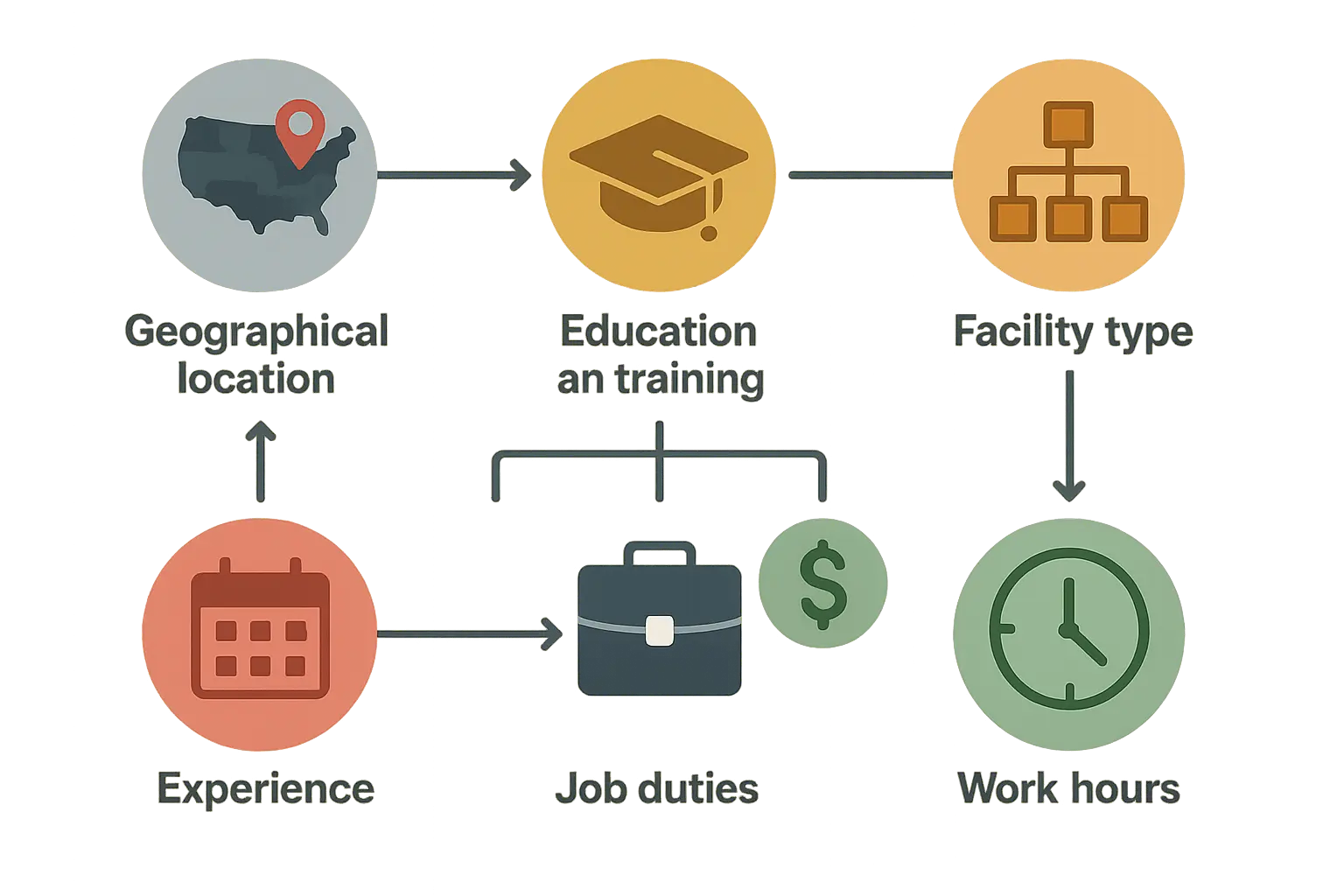
Not all healthcare jobs are created equal. Hospitals pay the most because the work is hardest. Nursing homes pay less but might be more chill. Home care can pay really well per hour, but you might not get as many hours.
Different healthcare settings create different pay structures based on their patient populations, funding sources, and how they operate. The sicker the patients, the more complex the work, the more they usually pay.
Hospitals typically pay 15-25% more than nursing homes. We're talking $20-28 an hour in hospitals versus $17-22 in nursing homes. Why? Hospital patients are sicker, things change fast, and you need to know your stuff.
But before you automatically go for the hospital job, think about what you want. Hospital work is stressful. You might have 12-15 patients, they're all different levels of sick, and doctors are constantly changing orders. Nursing home work is more predictable – you get to know your residents, and while it's still hard work, it's not as chaotic.
My friend Maria works at a nursing home in Brooklyn. She makes $21 an hour, which is less than she could make at a hospital, but she's been there three years and knows all her residents. She actually likes going to work most days, which is worth something.
According to Nurse.org, hospitals pay CNAs an average of $38,920 annually, while nursing care facilities average $37,780, with NYC rates typically 20-25% higher than these national figures.
Home healthcare is interesting. You can make $22-30 an hour, which sounds great, but you might only get 20-30 hours a week. Plus, you're driving all over the city, dealing with different families, and working alone.
Some CNAs love it – you get one-on-one time with patients, families really appreciate you, and you have more control over how you do things. Others hate it because you never know what you're walking into, and if a client cancels, you're out that money.
Private duty can pay even more. I know a CNA who works nights for one family – $28 an hour, 40 hours a week, and they treat her like family. But finding those jobs takes time and connections.
Here's where you can really boost your income – work the shifts nobody else wants. Evening shift usually gets you an extra $2-4 an hour. Nights? That's $3-6 more per hour. Weekends and holidays? Even more.
Do the math – if you work nights and make an extra $4 an hour, that's over $8,000 more per year. Suddenly that $20 an hour job becomes a $24 an hour job.
Weekends usually get you an extra $1-3 an hour, and holidays can be time-and-a-half or double time. I know CNAs who volunteer for every holiday shift because the money is just too good to pass up.
My buddy Mike works every Christmas and Thanksgiving. He says it's worth it because he makes an extra $500-800 each holiday, and honestly, he'd rather be at work than dealing with his crazy family anyway.
Weekend differentials might seem small, but they add up quickly. Working every weekend with a $2/hour differential adds over $800 annually to your income, not counting any overtime opportunities that frequently come up during weekend shifts.
Marcus, a CNA at Mount Sinai, strategically works every other weekend and volunteers for holiday shifts. His base pay of $24/hour increases to $26/hour on weekends and $36/hour on holidays, adding an extra $4,200 to his annual income.
Overtime is everywhere in NYC healthcare right now. Facilities are so short-staffed that if you want to work extra, they'll let you. Time-and-a-half adds up fast – we're talking potential increases of 20-30% to your annual earnings.
But here's the thing – don't go crazy with overtime. Yeah, the money is tempting, but this job is physically and emotionally demanding. Burning yourself out isn't worth a few extra thousand dollars.
Many CNAs find that overtime opportunities often come from actual patient care needs. When facilities are short-staff ed, your willingness to work additional hours directly impacts patient safety and care quality. Many CNAs find satisfaction in knowing their overtime work makes a meaningful difference in patient outcomes.
The cool thing about being a CNA is that you don't have to stay a CNA forever. There are tons of ways to move up, make more money, or transition into other healthcare roles without necessarily going back to school for years.
Healthcare facilities value continuous learning and professional development, creating clear routes for salary growth. You can increase your value through specialized certifications, leadership roles, mentoring responsibilities, or developing expertise in specific patient populations.
According to Red Cross, "overall employment is expected to grow four percent between now and 2032" with "210,000 openings each year over the next decade," which means plenty of opportunities to move up.

Getting additional certifications is probably the easiest way to boost your pay. Medication administration, wound care, dementia care – these can add $1-4 an hour to your base pay. Plus, they make you way more valuable to employers.
The medication administration certification is huge. It lets you do things that usually only nurses can do, and facilities will pay extra for that. It's like getting a promotion without changing jobs.
The return on investment is excellent. A certification that costs a few hundred dollars and requires several weeks of study can result in thousands of dollars in additional annual income. More importantly, these credentials often lead to more interesting work assignments and greater job security.
Here's what smart CNAs focus on:
Wound care certification is another good one, especially with all the diabetic and elderly patients who have chronic wounds. If you become the go-to person for wound care, you're suddenly indispensable.
Dementia care certification might not sound exciting, but with the aging population, it's becoming really valuable. Plus, it actually makes your job easier because you understand why patients with dementia act the way they do.
These specialized skills are in high demand across NYC healthcare facilities, particularly as patient populations become more complex and healthcare delivery becomes more specialized.
If you're good at your job and people like working with you, leadership roles are a natural next step. Charge aide, unit coordinator, preceptor – these usually pay $3-7 more per hour than regular CNA work.
The thing about leadership roles is they're not just about patient care anymore. You're dealing with schedules, training new people, and solving problems. Some people love it, others hate it. But the money is definitely better.
Training and education roles are particularly rewarding for CNAs who enjoy sharing knowledge and helping others succeed. Many facilities employ experienced CNAs as clinical instructors or preceptors, roles that often come with regular business hours and enhanced compensation.
A lot of CNAs use the job as a stepping stone to become LPNs or RNs. Many hospitals will help pay for school and work around your class schedule. It's actually a pretty smart way to advance your career without going broke.
Jennifer worked as a CNA at NYU Langone for three years, then used their bridge program to become an RN. They paid for most of her schooling and guaranteed her a job when she graduated. Now she's making $85K a year instead of $45K.
CNA experience provides invaluable preparation for advanced nursing roles. You'll enter LPN or RN programs with hands-on patient care experience, understanding of healthcare facility operations, and established relationships with healthcare professionals who can serve as mentors and references.
Don't just look at the hourly rate – benefits matter a lot. Health insurance alone can be worth $10K-15K a year. Add in retirement matching, paid time off, and tuition assistance, and you're looking at significant additional value.
Some places have amazing benefits that make up for slightly lower pay. Others pay well but the benefits suck. You need to look at the whole package.
|
Benefit Type |
What It's Worth |
What You Get |
|
Health Insurance |
$8,000-$15,000/year |
Medical, dental, vision coverage |
|
Retirement Plans |
3-6% employer match |
401(k) with company contributions |
|
Paid Time Off |
$2,000-$4,000/year |
Vacation, sick days, personal time |
|
Professional Development |
$1,000-$3,000/year |
Tuition help, training money |
|
Life Insurance |
$500-$1,500/year |
Basic and supplemental coverage |

Most full-time CNA jobs come with health insurance, and the employer usually pays most of it. This is huge – individual health insurance in NYC can cost $500-800 a month. When your job covers it, that's like getting a $6K-10K raise.
Healthcare benefits are particularly valuable for CNAs, who face occupational hazards and physical demands that make comprehensive medical coverage essential. Quality insurance plans provide peace of mind and financial protection for work-related injuries or illnesses.
Many healthcare employers offer 401(k) plans with matching contributions of 3-6%, plus some unionized positions include pension plans for additional long-term financial security. This might seem less important early in your career, but starting contributions immediately maximizes compound growth.
Employer matching is basically free money that can significantly impact your long-term financial security. Even if you can only contribute a little bit, at least get that match.
Flexible scheduling, generous PTO policies, and reasonable workloads are worth money too. If you're constantly stressed out and never see your family, what's the point of making good money?
Look for places that actually care about their staff. They exist, and they're usually the ones with lower turnover and happier employees. NYC healthcare facilities increasingly offer flexible scheduling and compressed work weeks to attract and retain CNAs in this competitive market.
The job market for CNAs in NYC is really good right now, and it's going to stay that way. The population is aging, more people have health insurance, and there just aren't enough healthcare workers to go around.
This creates favorable conditions for salary growth and job security, with projections showing 8-10% growth in CNA positions through 2031. NYC is expected to see even higher demand due to population density and healthcare infrastructure expansion.

The Bureau of Labor Statistics says CNA jobs will grow 8-10% through 2031, and NYC will probably do even better than that. Translation: job security.
Demographic trends strongly support continued demand for CNA services. As baby boomers age and require more healthcare services, the need for skilled nursing assistants will continue growing. NYC's diverse population and concentration of healthcare facilities position the city as a leader in healthcare job growth.
A lot of CNAs in NYC are union members, especially 1199SEIU. Union jobs usually pay 10-20% more than non-union, plus you get better benefits and job protection.
If you have the choice between a union and non-union job, seriously consider the union option. Yeah, you pay dues, but you usually make that back in higher wages and better benefits. Union representation provides collective bargaining power that individual CNAs can't achieve alone.
The staffing shortage is real, and it's working in your favor. Facilities are offering signing bonuses, retention bonuses, and better working conditions because they're desperate for good people.
This is actually a great time to be looking for CNA work in NYC. You have leverage you wouldn't have had five years ago. Ongoing staffing challenges have created a competitive environment where facilities offer signing bonuses ($1,000-$5,000), retention bonuses, and accelerated pay increases to attract and keep qualified CNAs.

Here's the thing about working as a CNA in NYC – the job is demanding enough without having to worry about crazy rent and roommate drama. Outpost Club gets that healthcare workers need flexible, affordable housing that doesn't eat up half your paycheck.
Their co-living setups are perfect for CNAs. You get your own room, but you're not stuck with a year-long lease if you land a better job across town. Plus, you're living with other working professionals who understand that sometimes you come home exhausted and just need quiet.
Healthcare professionals often benefit from affordable housing options in NYC that allow them to save money while building their careers in demanding fields.
Healthcare professionals face unique housing challenges in NYC – irregular schedules, potential job changes, and the need for quiet spaces to rest between demanding shifts. Outpost Club's model addresses these needs with flexible lease terms, furnished spaces, and built-in community connections.
Understanding how much you need to make to live in NYC becomes especially important for CNAs planning their career progression and housing decisions.
Ready to focus on your CNA career growth without housing stress? Explore Outpost Club's healthcare professional-friendly housing options and discover how the right living situation can accelerate your professional success.
For those considering different neighborhoods based on their workplace locations, our guides on living in Manhattan and Brooklyn neighborhoods can help healthcare workers make informed housing decisions.

Look, being a CNA in NYC isn't going to make you rich, but it can definitely give you a decent living. The pay is better than most places in the country, there are tons of opportunities to advance, and the job market is strong.
The key is being smart about it. Pick the right facility, work some premium shifts, get a few certifications, and don't be afraid to move around if you find better opportunities. Treat it like a career, not just a job, and you can do pretty well for yourself.
And honestly? In a city where a lot of people are struggling to make ends meet, having a stable job that pays $45K-60K a year with good benefits isn't too bad. Plus, you're actually helping people, which counts for something.
For new healthcare professionals navigating the transition to NYC, resources on how to budget for an apartment can help ensure that career growth translates into sustainable financial planning.
The CNA profession in NYC offers substantial earning potential and career growth opportunities that reflect how essential this work really is. With starting salaries significantly above national averages, multiple pathways for advancement, and strong job security projections, pursuing a CNA career in New York City represents a solid investment in your professional future.
Success in this field requires dedication to continuous learning, willingness to adapt to changing healthcare needs, and commitment to providing compassionate patient care, but the rewards – both financial and personal – make it a worthwhile career choice for those called to healthcare service.

Household supplies can be changed or decreaased at Outpost Club’s discretion, or based on supply availability. Outpost is not responsible for temporary losses of utility service. Outpost Club is not responsible for any damages due to absence of any supplies or utilities


If you have a sales related question please call
680-688-7678

 Hot Deals