LPN Salary NYC: What Licensed Practical Nurses Actually Earn in the Big Apple
Dec 12, 2025

Dec 12, 2025
Look, I'm going to be straight with you about working as an LPN in New York City. Yes, you can make good money here - we're talking $55,000 to $75,000 a year, with some experienced nurses pushing $85,000. But before you start dreaming about that salary bump, let me paint you the real picture.
According to 4 Corner Resources salary data, LPN salary NYC figures are 39% higher than the national average of $64,735. That premium is legit. But here's what nobody tells you in those glossy recruitment brochures: every dollar of that premium gets tested against the reality of NYC living. Your rent alone will probably eat up 40-50% of your paycheck, and that's if you're lucky enough to find something decent.
I've watched plenty of nurses move here thinking they'd struck gold, only to realize that $75k in NYC hits different than $75k literally anywhere else. But here's the thing - if you're smart about it, you can absolutely make this work and build a career that's both financially rewarding and professionally fulfilling.
The variety of opportunities here is insane. One day you might be working in a world-class teaching hospital in Manhattan, the next you could be doing home visits in Brooklyn. Each setting has its own vibe, its own pay structure, and its own way of either burning you out or building you up.
What makes NYC different isn't just the bigger paychecks. It's the pace, the diversity of patients, the complexity of cases you'll see. You'll learn more in your first year here than some nurses learn in five years elsewhere. That experience becomes currency you can cash in throughout your entire career.
Understanding the broader cost of living in Manhattan context is crucial when evaluating these salary figures, as housing and transportation expenses significantly impact your take-home value.
According to the Bureau of Labor Statistics data from Nightingale College, the median salary for licensed practical nurses nationally is $63,540 per year, which translates to $30.55 per hour, highlighting just how much that NYC premium can mean for your bank account.
Here's where it gets interesting - and where you need to pay attention because this directly impacts your bank account. Not all healthcare jobs are created equal, and in NYC, where you work matters just as much as what you do.
|
Healthcare Setting |
Average Hourly Rate |
Annual Salary Range |
Key Benefits |
|
Major Hospital Systems |
$28-35/hour |
$58,240-$72,800 |
Comprehensive benefits, shift differentials |
|
Specialty Hospitals |
$30-40/hour |
$62,400-$83,200 |
Premium pay, specialized training |
|
Skilled Nursing Facilities |
$25-32/hour |
$52,000-$66,560 |
Sign-on bonuses, stable schedules |
|
Home Healthcare |
$35-50/hour |
$45-65/visit |
Flexible scheduling, per-visit rates |
|
Outpatient Centers |
$26-33/hour |
$54,080-$68,640 |
Regular hours, lower stress |
Hospital systems are where the big money lives. We're talking $28-35 an hour to start, but that's just the beginning. Night differentials, weekend premiums, overtime opportunities - it all adds up fast. I know LPNs pulling in $80k+ because they're strategic about picking up extra shifts and working the system.
But hospitals aren't for everyone. The pace is relentless, the pressure is real, and some days you'll feel like you're drinking from a fire hose. If that sounds overwhelming, don't worry - there are other paths.
Skilled nursing facilities might pay a bit less on paper - $25-32 an hour - but many are throwing around sign-on bonuses like confetti right now. We're talking $2,000-5,000 just for walking in the door, plus retention bonuses if you stick around. The math starts looking pretty good when you factor that in.
Home healthcare is the wild card. Some agencies pay per visit ($45-65 each), others do hourly private duty at $35-50. If you're organized and don't mind driving around the city, you can actually make more than your hospital friends while having way more flexibility.

The key is figuring out what works for your lifestyle and your financial goals. Are you willing to deal with hospital chaos for higher base pay? Do you prefer building relationships with long-term care residents? Or maybe you're the type who loves the independence of home healthcare? There's no wrong answer, just different paths to the same destination.
Let's talk about the big leagues - Manhattan's major medical centers. Places like NYU Langone, Mount Sinai, NewYork-Presbyterian. These aren't just hospitals; they're healthcare empires, and they pay like it.
Starting at $28-35 an hour sounds nice, but here's where it gets really interesting. Night shift differential? That's an extra 10-15% on top of your base. Weekend premium? Another 10%. Suddenly you're looking at $37-40 an hour for weekend nights, and those shifts add up fast.
I know an LPN named Sarah at NYU Langone who figured this out early. She started at $30 base, but by strategically working nights and weekends, she's pulling in over $75k a year. The trade-off? She sleeps when the rest of the world is awake, and her social life revolves around other healthcare workers with weird schedules.
The benefits at these major centers are honestly ridiculous. Health insurance that would cost you $15k+ on your own, retirement matching, PTO that actually lets you take real vacations. When you add it all up, you're looking at total compensation packages that can hit $90k+.
Specialty hospitals are where things get really spicy. Rehab centers, psych facilities, specialty care - they're often willing to pay $30-40 an hour for the right experience. The patient ratios are usually better, the pace is more manageable, and if you've got specialized skills, you become incredibly valuable.
These facilities value expertise over volume. If you've got experience in mental health, rehabilitation nursing, or other specialized areas, you're looking at some of the highest hourly rates available to LPNs in the city. Plus, you'll actually have time to provide quality care instead of running around like your hair's on fire.
But here's the reality check: these premium positions don't just fall into your lap. You need to prove yourself, build relationships, and sometimes put in time at less glamorous places first. The good news? In a city this size, there are always opportunities to move up if you're willing to do the work.
According to Bureau of Labor Statistics data, general medical and surgical hospitals employ 86,900 or 13.74% of all LPNs nationwide, with an average yearly salary of $58,500, demonstrating the significant earning advantage that NYC hospital LPNs enjoy over the national average.
Okay, let's talk about the sector that doesn't get enough love - long-term care. I get it, it's not as flashy as working at a famous Manhattan hospital, but hear me out. This is where a lot of smart LPNs are building solid, sustainable careers.
Skilled nursing facilities are desperate for good nurses right now. Like, really desperate. That's why you're seeing $25-32 an hour plus sign-on bonuses that can hit $5,000. Some places are even offering retention bonuses every quarter you stay. Do the math - that's potentially an extra $8,000-10,000 a year just for showing up and doing good work.

What I love about long-term care is the relationships. You're not just treating patients; you're becoming part of their lives, their families' lives. Mrs. Rodriguez in room 12 knows your coffee order. Mr. Thompson lights up when you walk into his room. That kind of connection makes even the tough days worth it.
Memory care units are the premium segment here. Dementia and Alzheimer's care requires special skills and infinite patience, but facilities pay 15-20% above standard rates for it. If you have the temperament for it - and not everyone does - you can earn hospital-level wages with better work-life balance.
The career growth potential in long-term care is real. Charge nurse positions, unit supervisor roles, even facility management - there are clear paths upward for LPNs who want to advance. And with the aging population, job security in this sector is about as solid as it gets.
The Bureau of Labor Statistics reports that nursing care facilities employ the largest percentage of LPNs at 178,880 or 28.28% of all licensed practical nurses, with an average yearly salary of $67,420, indicating strong job security and competitive wages in this sector.
Home healthcare is exploding in NYC, and it's creating some really interesting opportunities for LPNs who want to think outside the traditional healthcare box.
The pay structure is completely different from what you're used to. Instead of hourly wages, many agencies pay per visit - typically $45-65 per visit. The trick is efficiency and geography. If you can cluster your visits in one neighborhood and manage your time well, you can actually out-earn your hospital friends.
I know an LPN named Maria who's mastered this. She schedules 8 visits a day in Brooklyn, all within a few subway stops of each other. At $55 per visit, she's pulling in $440 a day, which works out to about $35 an hour when you factor in travel time. Plus, she sets her own schedule and never has to deal with hospital politics.

Private duty nursing is the premium end of home healthcare. You're providing one-on-one care, often for patients with complex needs, and the hourly rates reflect that responsibility - $35-50 an hour. Overnight assignments and weekend private duty can command even higher rates.
The flexibility is unreal. Want to take a long weekend? Just don't schedule visits. Need to attend a family event? Move your patients around. Try doing that in a hospital setting.
But let's be honest about the challenges. You're driving all over the city, dealing with parking, managing your own schedule, and sometimes working in less-than-ideal home environments. It's not for everyone, but for the right person, it can be incredibly rewarding both personally and financially.
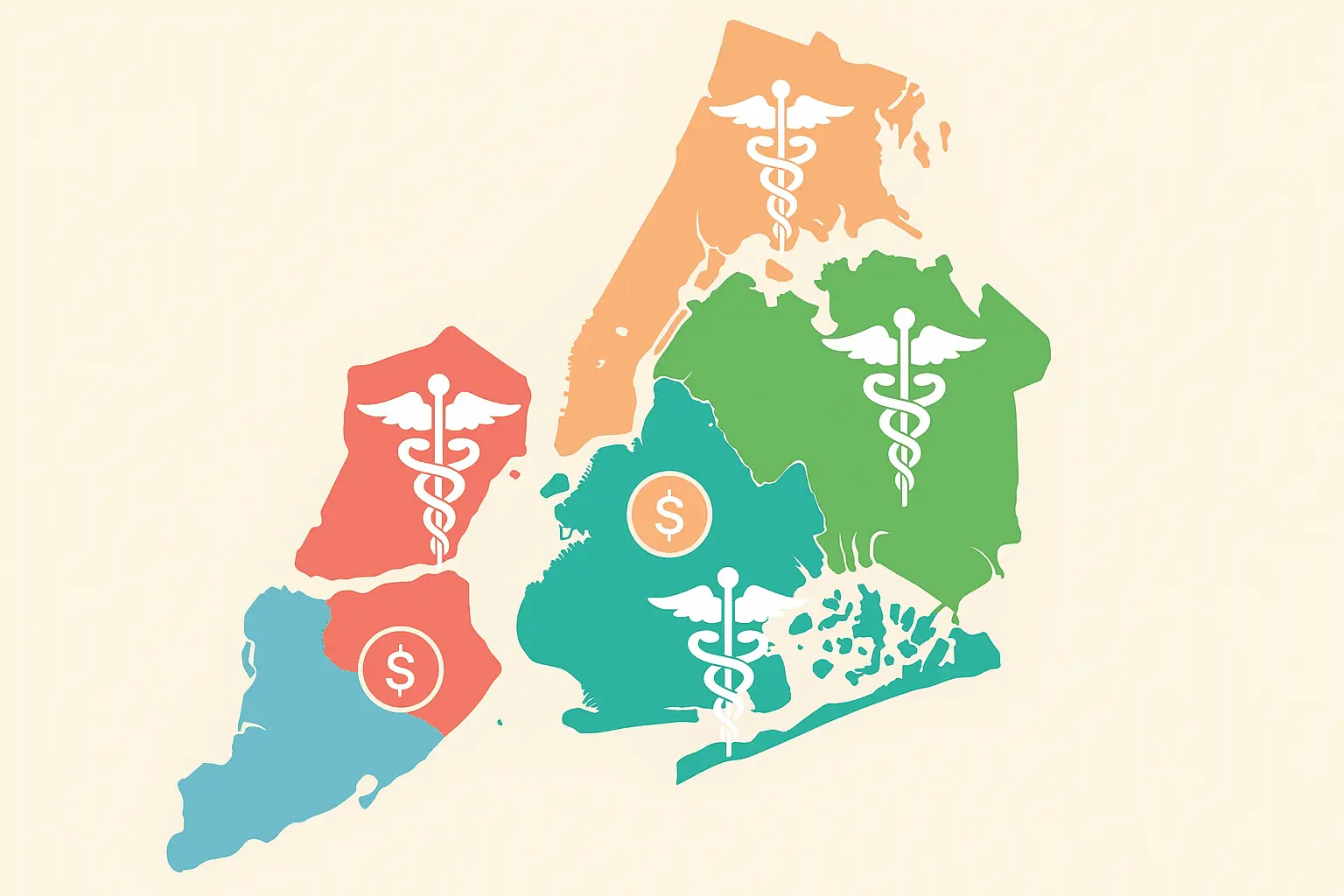
Here's something that might surprise you - where you work in NYC can make a real difference in your paycheck. Each borough has its own healthcare ecosystem, and the pay reflects local market conditions.
|
Borough |
Average Hourly Rate |
Cost of Living Impact |
Commute Factor |
Key Healthcare Employers |
|
Manhattan |
$32-38/hour |
Highest expenses |
Central location |
NYU Langone, Mount Sinai, NewYork-Presbyterian |
|
Brooklyn |
$28-34/hour |
Moderate expenses |
Varied commutes |
NYU Langone Brooklyn, BronxCare |
|
Queens |
$27-33/hour |
Moderate expenses |
Longer commutes |
NYC Health + Hospitals/Queens |
|
Bronx |
$26-32/hour |
Lower expenses |
Shorter commutes |
Montefiore, BronxCare Health System |
|
Staten Island |
$25-31/hour |
Lowest expenses |
Isolated location |
Staten Island University Hospital |
Manhattan is the premium market. Medical facilities there often pay 10-15% above city averages because they're competing for talent in the most expensive real estate market in the country. The Upper East Side medical corridor? Those facilities know they need to pay top dollar to attract good nurses.
But here's the catch - that higher salary comes with higher everything else. Lunch near those fancy hospitals costs twice what you'd pay in Queens. Parking, if you can find it, might cost more per day than some people spend on groceries.
For healthcare professionals considering Manhattan employment, understanding where to live in Manhattan becomes crucial for balancing salary benefits with housing expenses and commute times.
Brooklyn and Queens are where a lot of smart LPNs are landing. The pay is still competitive - often just $2-3 less per hour than Manhattan - but your money goes further. You might actually be able to afford to live reasonably close to work, which is worth something when you're pulling 12-hour shifts.
Brooklyn's healthcare landscape includes everything from major medical centers like NYU Langone Brooklyn to community hospitals and long-term care facilities. Queens offers similar diversity with the added benefit of being home to several major hospital systems.
Healthcare workers often find Brooklyn's coolest neighborhoods provide excellent work-life balance with reasonable commutes to Manhattan medical centers when needed.
The Bronx and Staten Island traditionally pay a bit less, but they're catching up fast as healthcare demand grows. Plus, the cost of living is lower, commutes can be shorter, and the community feel in these boroughs' healthcare facilities is often stronger.
Don't just look at the hourly rate - factor in your total cost of working. If that Manhattan job pays $5 more per hour but costs you $20 a day in parking and doubles your commute time, is it really worth it?
Alright, let's get tactical. If you want to maximize your earning potential as an LPN in NYC, you need to be strategic about building your skills and positioning yourself for better opportunities.
IV therapy certification is probably the smartest investment you can make. It costs a few hundred dollars and takes a weekend, but it can bump your hourly rate by $2-5 across almost every healthcare setting. Do the math - that's potentially $4,000-10,000 more per year for one weekend of training.
Wound care specialization is another goldmine, especially in long-term care where complex wound management is a daily reality. These aren't just nice-to-have skills; they make you indispensable.
LPN Salary Enhancement Checklist:
But here's what really moves the needle - experience in high-acuity settings. Starting your career in a busy hospital or large nursing home might be overwhelming, but you'll see more conditions and handle more complex situations in six months than some nurses see in years. That experience becomes your ticket to higher-paying positions later.
Language skills are huge in NYC. If you're bilingual, especially in Spanish, you're looking at language differentials of $1-3 per hour. In a city as diverse as New York, these skills aren't just helpful - they're often essential for providing quality care.
Don't sleep on the soft skills either. Being reliable, showing up on time, getting along with difficult patients and families - these things get noticed. The LPNs who advance fastest aren't necessarily the smartest or most skilled; they're the ones people want to work with.
Successful salary negotiation starts with understanding your market value. Regularly review salary surveys, job postings, and industry reports to stay informed about current compensation trends in your specialty and geographic area.
Document everything that makes you valuable - certifications, continuing education, positive performance reviews, and any special projects or responsibilities you've taken on. This documentation becomes your ammunition during salary discussions and performance reviews.

Take James, an LPN with 3 years experience who increased his hourly rate from $28 to $34 by obtaining IV therapy certification ($3/hour increase) and Spanish language proficiency ($2/hour differential), plus negotiating a $1/hour experience adjustment based on documented performance metrics. That's an extra $12,000 annually for strategic skill building.
Here's something a lot of LPNs don't think about when comparing job offers - your base salary is just part of the picture. The benefits and perks can add serious value to your total compensation package.
Health insurance through your employer can be worth $10,000-15,000 annually compared to what you'd pay for similar coverage on your own. And in healthcare, where occupational injuries and exposures are always possible, good insurance isn't just nice to have - it's essential.
Many NYC healthcare employers offer premium plans with low deductibles and extensive provider networks. Don't underestimate the value of good health insurance, especially working in healthcare where occupational injuries and exposures are always possible.
Retirement benefits might seem boring when you're focused on paying rent, but even a modest 3% employer match on a $65,000 salary adds nearly $2,000 per year to your compensation. Some of the larger hospital systems still offer pension plans, which are becoming rare everywhere else.
Some of the larger hospital systems still offer defined benefit pension plans, which are becoming increasingly rare in other industries. These plans can provide significant retirement security if you stay with the organization long-term.
Paid time off is another big value-add. Many NYC healthcare facilities offer 3-4 weeks of vacation plus separate sick leave. When you calculate the value of that time off at your hourly rate, it represents thousands of dollars in additional compensation.
Tuition reimbursement and continuing education allowances provide both immediate financial value and long-term career benefits. Many employers will pay for additional certifications, conference attendance, or even degree programs that advance your career.
The key is looking at the total package, not just the hourly rate. Sometimes a job that pays $2 less per hour but offers better benefits ends up being worth more in the long run.

The future looks bright for LPNs in NYC. The healthcare market here is expanding, particularly in home healthcare and outpatient services. This growth is driving increased demand for LPNs, with projected job growth well above the national average.
Technology is creating new opportunities for tech-savvy LPNs. Electronic health records, telehealth services, remote monitoring - facilities need nurses who can adapt to new systems and help train others. Being the go-to person for technology issues can set you apart and command premium compensation.
The aging population impact is massive. New York's demographics are creating sustained demand for LPNs in geriatric care settings. Many facilities are offering retention bonuses and career advancement programs because they know experienced geriatric nurses are gold.
The nursing profession has gained increased visibility and recognition, as demonstrated by "Love Island USA Season 7 featuring nurses Amaya Espinal and Nic Vansteenberghe", highlighting how healthcare professionals are being celebrated in popular culture and potentially inspiring more people to consider nursing careers.
Bridge to RN programs represent the biggest opportunity for long-term earning growth. Many NYC hospitals offer tuition assistance for LPNs pursuing RN degrees, with RNs typically earning $75,000-$95,000 annually. Major health systems like NYU Langone and Mount Sinai offer programs that let you work while completing your education, often with guaranteed employment upon graduation.
The investment in advancing your education pays off quickly in NYC's market. The salary jump from LPN to RN can be $20,000+ annually, and the career opportunities expand dramatically.
Educational opportunities are expanding, with institutions like "Borough of Manhattan Community College (BMCC) offering a comprehensive LPN certificate program" that consists of 46 credits and prepares students for the NCLEX-PN examination, demonstrating the growing educational infrastructure supporting LPN career development in NYC.

Let's be real about the challenges, because pretending they don't exist doesn't help anyone make informed decisions.
Housing costs are brutal. With average rent consuming 40-50% of an LPN's gross income, many healthcare workers need to get creative. Roommates, outer borough commutes, co-living arrangements - you'll need to think outside the box to make the numbers work.
Transportation adds another layer of expense and complexity. Monthly MetroCard costs, potential parking fees for night shifts, the occasional Uber when the subway isn't running - it adds up to $200-400 monthly easily.
The work environment in NYC is intense. High patient-to-nurse ratios, diverse patient populations requiring cultural competency, the general pace of everything - it can be overwhelming, especially when you're starting out.
Language barriers are real. Even if you're not bilingual, you'll need to learn to communicate effectively with patients who speak limited English. It's part of the job, but it adds complexity to every interaction. Bilingual LPNs, particularly those fluent in Spanish, often receive language differentials of $1-3 per hour.
Union considerations affect many NYC healthcare facilities. While unions provide job security and standardized pay scales, they may limit your ability to negotiate individual salary increases. Understanding the union landscape in your chosen setting is important for setting realistic expectations.
Union contracts often include automatic step increases based on years of service, which provides predictable salary growth but may cap your earning potential compared to non-union facilities where individual performance can drive compensation increases.

Finding the right LPN position in NYC requires strategy beyond just browsing job boards and hoping for the best.
Networking is everything in NYC healthcare. Join the New York State Association for Licensed Practical Nurses, attend their events, meet people. The best jobs often get filled through connections before they're ever posted publicly.
Healthcare job fairs are gold mines. Hiring managers and recruiters prefer meeting candidates in person rather than sorting through hundreds of online applications. Come prepared with your elevator pitch and questions about compensation and growth opportunities.
NYC LPN Job Search Strategy Checklist:
Don't underestimate social media networking. LinkedIn groups for NYC healthcare professionals share job leads and salary information that isn't available elsewhere. Follow major hospital systems on social media - they often post opportunities and give insights into their culture.
Healthcare-specific job boards and hospital system websites provide the most current salary information and position availability. Sites like HealthJobsNationwide and individual hospital career pages often list salary ranges and benefits information upfront.
Staffing agencies can offer higher hourly rates for per diem work, though typically without benefits. Some LPNs use this strategically - working agency for higher hourly rates while maintaining a part-time permanent position for benefits.
Some LPNs use agency work strategically – working per diem to earn higher hourly rates while maintaining a part-time permanent position for benefits. This hybrid approach can maximize both income and security.

Housing is the make-or-break factor for LPNs in NYC. Get this wrong, and even a great salary won't make your life comfortable.
Traditional one-bedroom apartments in Manhattan can easily cost $3,500-4,500 monthly. That would require an annual salary of $105,000+ to maintain the recommended 30% housing-to-income ratio. For most LPNs, that math just doesn't work.
Understanding the cost of living in Brooklyn versus Manhattan can help LPNs make informed decisions about where to live while maintaining reasonable commutes to work.
This reality forces creative solutions. Shared housing and co-living arrangements can reduce your housing costs to $1,200-2,000 monthly while providing community connections with other working professionals who understand healthcare schedules.
Location matters more when you're working 12-hour shifts or overnight assignments. Living close to work or near reliable public transportation becomes essential when you're exhausted after a long shift and just want to get home safely.
Many successful LPNs in NYC prioritize housing that supports their work schedule over housing that looks impressive. A shorter commute and reliable roommates often matter more than having your own place in a trendy neighborhood.

For LPNs working in NYC's demanding healthcare environment, finding housing that supports both your financial goals and work-life balance is crucial . Co-living spaces designed for working professionals offer an attractive solution, providing well-maintained properties with like-minded individuals at rates more affordable than traditional NYC apartments.
Healthcare professionals often benefit from exploring affordable neighborhoods in NYC that offer good value while maintaining access to major medical centers.
This type of supportive living environment can be particularly valuable for traveling nurses, new graduates, or LPNs looking to maximize their savings while building their careers. Move-in ready spaces with utilities and amenities included allow healthcare professionals to focus on their demanding careers without the stress of apartment hunting or maintenance responsibilities.
For LPNs working long shifts and irregular hours, Outpost Club's co-living communities provide the convenience and community support that can be instrumental in maintaining both professional performance and personal well-being in New York City's competitive healthcare landscape.
Working as an LPN in New York City offers some of the best earning potential in the country, but success requires more than just showing up with your license. The $55,000-$85,000 salary range represents real money that can support a good quality of life, but only if you're strategic about managing the city's high costs and competitive healthcare environment.
Your path to maximizing your LPN salary in NYC starts with understanding the different healthcare settings and their compensation structures. Whether you choose the high-pressure, high-reward environment of major medical centers or the relationship-focused world of long-term care, each setting offers unique opportunities for both financial and professional growth.
The key to long-term success lies in continuous skill development and strategic career planning. Additional certifications, specialty training, and eventually pursuing your RN degree can dramatically increase your earning potential over time. The investment in your education and skills pays dividends throughout your career.
Don't underestimate the importance of finding the right living situation. Housing costs will be your biggest expense, and getting this right can make the difference between thriving and just surviving in NYC. Whether that means shared housing, co-living arrangements, or commuting from outer boroughs, your housing choice directly impacts your financial success.
For healthcare professionals considering the move to NYC, understanding how much you need to make to live in NYC provides essential context for salary negotiations and career planning.
The future outlook for LPNs in NYC remains strong, with growing demand across multiple healthcare sectors and clear pathways for career advancement. If you're willing to embrace the challenges and opportunities that come with working in one of the world's premier healthcare markets, the financial rewards can be substantial and the career satisfaction even greater.
Yes, it's expensive. Yes, it's demanding. But here's the thing - you're tougher than you think, and this city rewards people who show up and do the work. Every successful LPN here started exactly where you are now, wondering if they could make it work. Spoiler alert: they did, and so can you.

Household supplies can be changed or decreaased at Outpost Club’s discretion, or based on supply availability. Outpost is not responsible for temporary losses of utility service. Outpost Club is not responsible for any damages due to absence of any supplies or utilities


If you have a sales related question please call
680-688-7678

 Hot Deals