MSW Salary NYC: What Social Workers Actually Earn in the Big Apple (And How to Maximize Your Income)
Dec 16, 2025

Dec 16, 2025
So you're thinking about social work in NYC? Let me be real with you - I've been there. Fresh out of my MSW program, staring at job postings wondering if I could actually afford to help people in the most expensive city in America.
Look, let's cut through the BS here. You're entering one of the most competitive yet rewarding social work markets in the country, but nobody's going to sugarcoat what that actually means for your bank account. NYC's salary landscape isn't just about the numbers on your paycheck—it's about figuring out how to afford your tiny studio apartment while doing work that actually matters.
According to the U.S. Bureau of Labor Statistics, the median salary of a social worker in 2020 was $51,760 a year, which breaks down to $24.88 per hour. But here's the thing - NYC throws those numbers out the window. You're looking at a completely different game here, and honestly, that's both terrifying and exciting.
What makes NYC different? Well, for starters, you can't just wing it here. State licensing requirements actually create clear paths to better money, especially once you get your LCSW. Plus, a lot of public sector jobs have unions that'll fight for your paycheck, which is pretty rare in our field. And let's be honest - nowhere else has this many hospitals, private practices, and organizations all competing for good social workers.
Here's what's really happening on the ground: as noted in a recent opinion piece, "Social workers with a master's level education are the critical staff in these services. They are a major workforce in homeless and domestic violence shelters, in community mental health teams, in foster care and abuse, in health care, in services for the elderly, and in school services. Their median salary is just over $61,000" according to City & State NY. We're literally holding up the city's entire support system, but the pay still feels pretty insulting when you think about what we actually do all day.
Okay, geography lesson time. Manhattan pays the most because, well, it's Manhattan. All the fancy hospitals and high-end private practices are there, so they have to pay more to get people to show up. Makes sense, right?
Brooklyn and Queens? Not bad at all. You've got major medical centers, the commute's usually better, and if you're thinking about private practice someday, office space won't cost you your firstborn child. Understanding the cost differences across neighborhoods is crucial for social work professionals, especially when considering affordable neighborhoods in NYC that can help stretch your salary further.
The Bronx and Staten Island are interesting. Yeah, the base pay might be a little lower, but here's what nobody tells you - you'll actually have a life. Less competition for jobs, shorter commutes, and honestly, you can see your impact more directly. Plus, if you're smart about it, you can live in these areas and still take advantage of Manhattan's higher-paying opportunities.
One thing I learned the hard way - where you live affects your earning potential in ways you don't expect. If you're near wealthy neighborhoods like the Upper East Side or Tribeca, you're more likely to get referrals for private practice. But if you're in the outer boroughs, you might find office space you can actually afford when you're ready to go out on your own.
Fresh out of school? You're looking at $50,000 to $65,000 to start. I know that range seems huge, but there's a reason for it. Some places actually value what you bring to the table, and others... well, they're hoping you're desperate enough to take whatever they offer.
Hospital jobs usually start higher - around $58,000 - because they know you're going to hit the ground running with discharge planning and crisis intervention. Community mental health centers might start you lower, maybe $52,000, but here's the trade-off: the supervision and training you'll get is incredible. School districts land somewhere in the middle, but don't ignore those benefits and summers off.
Child protective services is tough work, but they often start around $60,000 with overtime opportunities that can seriously boost your first-year income. Just know what you're signing up for.
My friend Sarah went through this exact situation. Columbia MSW, three offers: Mount Sinai at $58,000, a community center at $52,000, and school district at $55,000. She was freaking out during her last semester, honestly had no idea how to compare them. The hospital gig paid the most upfront, but when she actually calculated the school benefits - full health coverage, pension plan, summers off - the total package was worth way more for her long-term goals.
Here's how to maximize your starting salary without being that annoying new grad:
This is where things get interesting. You're looking at $65,000 to $85,000, but more importantly, this is where your choices really start to matter.
Getting your LCSW is like getting a $10,000-$15,000 raise overnight. It's not just the letters after your name - it's about what you can actually do with clients and how organizations see your value. Research shows that MSW holders earn about 29 percent more than professionals with a bachelor's in social work, and LCSW credentials push that even higher.
Here's where you need to make some decisions. Do you want to move into supervision and management? Those jobs typically pay $75,000 to $90,000, but you're trading direct client work for administrative headaches. Or do you want to stay clinical and maybe start building toward private practice?
The social workers making the most money during this phase are the ones who specialize. Trauma therapy, substance abuse with dual diagnoses, working with specific populations like LGBTQ+ folks or veterans - that's where you can push into the $80,000 to $100,000+ range.
|
License Type |
Average NYC Salary |
National Average |
Salary Increase |
|
MSW Only |
$58,000-$65,000 |
$51,760 |
Baseline |
|
LGSW |
$62,000-$70,000 |
$58,000 |
+$4,000-$8,000 |
|
LCSW |
$72,000-$85,000 |
$73,000 |
+$14,000-$20,000 |
Once you've got 10+ years and the right credentials, you're looking at $90,000 to $150,000+. These aren't fantasy numbers - these are real jobs at places like Mount Sinai, NYU Langone, and major nonprofits.
Program directors and clinical supervisors aren't just seeing clients anymore. You're running programs, managing budgets, and actually shaping how services get delivered. You're not just providing direct service - you're influencing organizational direction and developing the next generation of social workers.
Executive roles - agency directors, chief clinical officers - can push past $150,000, but you're basically running a business at that point. These positions usually require advanced degrees beyond your MSW, extensive experience, and proven leadership skills you've built over years of progressive responsibility.

Hospital social workers make the most money among direct service providers, hands down. We're talking $70,000 to $95,000 for experienced clinicians at places like Mount Sinai, NYU Langone, and NewYork-Presbyterian. According to recent data, healthcare social workers earn a mean annual salary of $60,470, though NYC rates blow past national averages.
But it's not just the base salary that makes healthcare attractive. The benefits are usually incredible - health insurance, retirement matching, education support. And you're constantly learning because every day brings something different. Plus, you're working in environments where your clinical skills are constantly challenged and developed.
Specialized medical social work pays even more. Oncology, transplant services, emergency departments - if you can handle the intensity, these positions often pay above the standard range because they require specific knowledge and nerves of steel. Many also offer shift differentials for evening or weekend coverage.
Getting into healthcare takes some planning though. You need relevant field experience, medical terminology knowledge, and often specific certifications. But if you can get in, it's one of the most stable and well-compensated paths in our field.
Here's your game plan for healthcare social work:
A recent Money Diary from Refinery29 featured a healthcare social worker in New York earning $103,694 annually. That's real money that makes living in NYC actually feasible when you combine experience with specialized credentials.
This is where the real money is - $100,000 to $200,000+ if you do it right. But let me be clear: this isn't just about being a good therapist. You're running a business, which means marketing, billing, insurance headaches, and finding clients.
Most people don't jump straight into private practice. You need a few years of agency experience first to build your skills and professional network. A lot of successful private practitioners keep part-time agency work while building their caseload, which is honestly the smart way to do it.
My colleague Michael made this transition over 18 months. He dropped to 60% time at his $75,000 agency job while building his private practice. He was basically working two jobs that first year and learning business skills they never taught us in MSW school. By year two, he was making $120,000 seeing 25 clients a week at $150 per session. But that first year was brutal - he was working nights and weekends just to get his practice off the ground.
Success in private practice often comes down to your specialty and your ability to market effectively. Therapists who focus on couples work, trauma therapy, or specific populations often build sustainable practices faster than generalists.

NYC government jobs don't always pay the most, but they offer something private sector can't: predictability. Department of Social Services, Administration for Children's Services, Department of Health and Mental Hygiene - these places have clear salary scales and regular increases.
Child protective services starts around $60,000, but the advancement path is clear. Supervisory roles earning $80,000 to $100,000+ are realistic goals if you stick with it and get the right training. These positions often include overtime opportunities that can significantly boost annual earnings.
The union representation is huge here. SSEU Local 371 actually fights for salary increases and better working conditions. You might not be able to negotiate your individual salary, but you know exactly what to expect for advancement and raises. There's real job security here - something that's increasingly rare in our field.
The trade-off? Less flexibility for individual salary negotiation, but way more predictability in your career progression and compensation increases.
Non-profits employ tons of NYC social workers, with salaries typically ranging from $55,000 to $75,000 for experienced people. Places like Covenant House, BronxWorks, and Catholic Charities know they're competing for talent and try to make their packages competitive.
The base salary might not blow you away, but look at the whole package. Loan forgiveness programs can be worth thousands annually. Professional development opportunities and health benefits often beat what you'd get at smaller private practices.
Community mental health centers deserve special mention. The salary might be $50,000 to $70,000, but the clinical training you get can accelerate your entire career. Many offer tuition reimbursement and support for getting advanced certifications that'll pay off down the road.
|
Practice Setting |
Entry-Level Salary |
Mid-Career Salary |
Senior-Level Salary |
Key Benefits |
|
Hospital/Healthcare |
$55,000-$65,000 |
$70,000-$95,000 |
$90,000-$120,000 |
Health benefits, shift differentials |
|
Private Practice |
N/A |
$80,000-$150,000 |
$100,000-$200,000+ |
Highest earning potential, flexibility |
|
Government/Public |
$50,000-$60,000 |
$65,000-$85,000 |
$80,000-$110,000 |
Job security, pension, union protection |
|
Non-Profit |
$45,000-$55,000 |
$55,000-$75,000 |
$70,000-$95,000 |
Loan forgiveness, professional development |
Your MSW program matters more than people admit. Columbia, NYU, Fordham graduates often get higher starting offers, not just because of prestige, but because of the connections and field placements these schools provide. Recent data shows that $20,454 was the average tuition for a CSWE-accredited MSW program in New York as of the 2021-22 academic year, with 7,962 MSW degrees granted in New York in the 2020-21 academic year.
Advanced certifications translate directly to more money. Trauma therapy, substance abuse treatment, family therapy - these can add $5,000 to $15,000 to your annual salary, depending on demand in your area.
Here's what actually moves the needle:
Don't just do continuing education to maintain your license. Use it strategically to position yourself for better opportunities and salary increases. The social workers who invest in specialized training consistently see the biggest salary jumps over their careers.

If you're in a union job, that union is fighting for your paycheck. The Social Service Employees Union (SSEU) Local 371 represents thousands of city social workers and consistently negotiates competitive salaries and working conditions.
Union contracts remove the guesswork from career progression. You know exactly what raises to expect and when you'll be eligible for advancement. Contract negotiations often result in across-the-board increases that keep up with cost of living changes.
The downside? Less flexibility for individual negotiation. You can't usually negotiate your starting salary or ask for performance-based raises. But the job security and comprehensive benefits often make up for potentially lower base salaries compared to private sector positions.
Most social service organizations have limited flexibility with base salary because of funding constraints or union contracts. But they often have room to negotiate other parts of your package.
Focus on what makes you unique. Specialized training, language skills, experience with specific populations, relevant certifications - these give you leverage because organizations know they have real value to their programs.
Here's your step-by-step approach:
Many organizations can't increase base salary but might offer signing bonuses, faster advancement reviews, extra vacation time, or professional development funds that add real value to your package.
My friend Jennifer was offered $58,000 for a community mental health position. She researched comparable roles showing $62,000-$65,000 ranges and highlighted her bilingual Spanish skills and trauma certification. I remember her telling me she was so nervous she practiced in the mirror for a week. Turns out, they couldn't increase the base, but they offered a $3,000 signing bonus, $2,000 annual professional development fund, and accelerated review after 18 months instead of 24. That effectively increased her first-year compensation by over $4,000.
You've got several paths to higher salaries, and they all require different skills:
Clinical specialization means getting really good at specific treatments or populations. This can lead to private practice or specialized positions that pay premium rates. You're deepening your expertise rather than broadening your responsibilities.
Supervision and management requires leadership skills beyond clinical work. You need to learn personnel management and administration, but supervisory roles consistently pay more. You're trading some direct client contact for broader program impact.
Policy and advocacy opens doors to government agencies, large nonprofits, and advocacy organizations. These roles need research and writing skills, but can lead to influential, well-paid positions where you're shaping systems rather than just working within them.
Private practice entrepreneurship offers the highest earning potential but requires business skills most MSW programs don't teach. Marketing, billing, practice management - it's a whole different skill set that goes way beyond clinical work.

Housing will eat 30-50% of your salary, so you need to get creative. Tons of social workers share apartments or live in outer boroughs. There's no shame in that - it's just smart financial planning. Many social workers find that coliving in Brooklyn or coliving in Manhattan provides affordable housing solutions that help stretch their salary further while building professional networks.
Transportation costs seem high until you realize you're eliminating car ownership completely. No payments, insurance, parking, or maintenance. The subway becomes your office commute, your gym (if you count running for the train), and your daily dose of humanity. It's weirdly liberating not owning a car, even if you do occasionally miss having a trunk to ugly-cry in after difficult cases.
Income supplementation becomes crucial. Part-time clinical work, consultation, teaching - NYC's concentration of schools provides lots of adjunct opportunities for experienced practitioners. For social workers concerned about living costs, understanding the real cost of living in NYC is essential when evaluating salary offers and negotiating compensation packages.
Here's the reality: $70,000 doesn't go as far here as other places, but the professional opportunities, networking potential, and career advancement possibilities often justify the higher costs.
Don't get tunnel vision about base salary. The total package matters more, especially in NYC's expensive market.
Health insurance alone can be worth $15,000-$20,000 annually if you bought it yourself. Retirement contributions, even modest ones, add up significantly over time. Paid time off has real value when you calculate your effective hourly rate.
Student loan forgiveness programs deserve special attention. Some organizations offer programs worth thousands annually, effectively increasing your take-home pay by reducing monthly obligations. This is money back in your pocket every month.
Transit benefits can save $1,500+ annually. In a city where every dollar counts, these benefits add up to meaningful amounts. Professional development support, continuing education reimbursement, and conference attendance advance your career in ways that lead to future salary increases. Flexible scheduling and telehealth opportunities add value that's hard to quantify but makes a real difference in your quality of life.

Telehealth has completely changed what's possible in social work. You can serve clients across broader geographic areas while potentially maintaining NYC salary levels.
Some practitioners are finding they can live in lower-cost areas while keeping their NYC client base and salaries. You just need to understand licensing requirements across different states and build a practice that works effectively in a virtual environment.
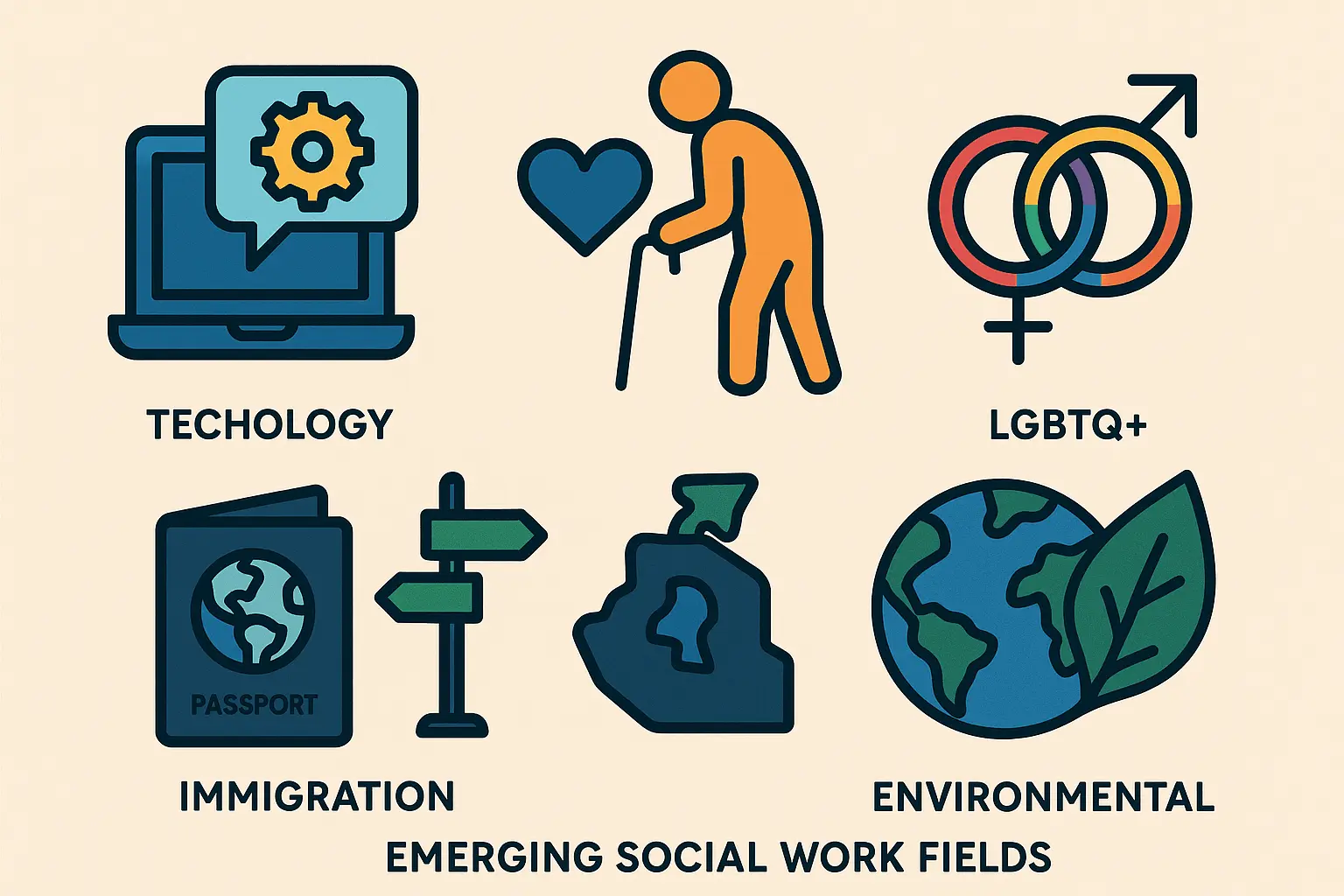
Technology companies represent entirely new employment for social workers. User experience, content moderation, employee wellness programs - these often pay $80,000-$120,000+, way higher than traditional social work. You're translating your understanding of human behavior and mental health into technology contexts, but the salary levels can dramatically improve your financial situation.
Several specializations show strong salary growth potential that can push you well above average social worker pay:
Elder care coordination is becoming huge as the population ages. Social workers with geriatric expertise, Medicare navigation, and family dynamics knowledge around aging are commanding premium rates.
LGBTQ+ affirming therapy continues growing as a specialty. Specific training in gender-affirming care, family therapy with LGBTQ+ individuals, or trauma-informed care for this population often leads to successful private practices or specialized positions within larger organizations.
Immigration services represent another growth area. Social workers who understand immigration law, refugee trauma, and cultural competency with immigrant populations are increasingly valuable.
Corporate employee assistance programs are expanding beyond traditional models. Companies are hiring social workers directly for on-site mental health services, crisis intervention, and workplace wellness programs.
Climate change and disaster response is emerging as a legitimate specialty with opportunities in both government agencies and consulting firms serving communities affected by environmental challenges.
Social work's demanding nature creates unique challenges for work-life balance. Irregular hours, crisis interventions, and high emotional demands make it tough to maintain personal relationships and community connections, regardless of your salary level.
Your career success isn't just about salary progression - it's about building a sustainable practice that lets you thrive personally while making professional impact. The most successful social workers find ways to decompress, build meaningful relationships outside work, and maintain perspective that prevents burnout.
Professional isolation is real, especially in private practice or high-stress agency environments. Building connections with colleagues and professionals from other fields provides the support network necessary for long-term sustainability. For social work professionals seeking work-life balance, exploring low cost therapy NYC options can provide valuable self-care resources that help maintain professional sustainability while managing tight budgets.
This is where organizations like The Outpost Club become particularly valuable for social work professionals. As an invitation-only golf society that brings together passionate individuals from across various professions, we offer social workers a unique opportunity to decompress, network, and build meaningful relationships outside their professional sphere. Social work professionals often benefit from exploring communal living spaces in NYC where they can connect with like-minded professionals who understand the demands of helping professions.
Our emphasis on genuine camaraderie and quality experiences provides exactly what many social workers need - a supportive community where you can relax, enjoy recreational activities, and connect with like-minded professionals who understand the importance of work-life balance.
With over 70 events annually and access to architecturally significant courses nationwide, The Outpost Club offers social workers the perfect antidote to high-stress work. For social work professionals who value both career success and personal fulfillment, we represent an investment in relationships and experiences that make demanding careers sustainable and enjoyable long-term.
If you're a social work professional looking to build meaningful connections beyond your practice, we'd love to learn more about you and potentially extend an invitation to join our community.

Look, social work in NYC is tough. The pay isn't always fair, the work is emotionally demanding, and sometimes you'll wonder if you can actually afford to help people in the most expensive city in America.
But here's what I've learned after years in this field: if you're strategic about your career choices, build the right skills, and don't settle for less than you're worth, you can make it work. NYC offers opportunities you won't find anywhere else - the diversity of practice settings, the professional networks, the sheer volume of learning experiences.
Your first job doesn't define your entire career. The skills you develop, the people you meet, and the strategic moves you make will ultimately determine both your paycheck and your job satisfaction. Focus on continuous learning, show up to those NASW happy hours even when you're tired, join the Facebook groups, text your field placement supervisor every few months just to check in.
This work matters. The city needs good social workers, and if you're smart about navigating the system, you can build a career that's both financially sustainable and personally fulfilling. Just maybe get a roommate first - trust me on that one.
The salary ranges I've shared are real, the opportunities exist, and the path forward is clearer than it might seem when you're starting out. Take it one step at a time, make strategic choices about your specializations and work settings, and remember that every experienced social worker in NYC started exactly where you are now - wondering if they could make it work.
You can. It just takes some planning, realistic expectations, and the willingness to advocate for yourself along the way.

Household supplies can be changed or decreaased at Outpost Club’s discretion, or based on supply availability. Outpost is not responsible for temporary losses of utility service. Outpost Club is not responsible for any damages due to absence of any supplies or utilities


If you have a sales related question please call
680-688-7678

 Hot Deals