Physician Assistant Salary NYC: The Real Numbers Behind Healthcare's Most Competitive Market
Dec 12, 2025

Dec 12, 2025
The concentration of world-class medical institutions in New York City has created an unprecedented demand for physician assistants, with the New York State Department of Labor predicting a 29.3% increase in PA positions between 2012 and 2022. This explosive growth, combined with the city's high cost of living and competitive healthcare landscape, has positioned NYC as the pinnacle of PA compensation nationwide.
Look, let's cut through the BS here. NYC's physician assistant salary market is absolutely wild right now, and I'm not just talking about the numbers you see on salary websites. I've been watching this market for years, and honestly? It's kind of insane what's happening.
You've got these massive health systems basically in a bidding war for anyone with a pulse and a PA license. I'm talking about places like NewYork-Presbyterian and Mount Sinai literally poaching people from each other with offers that would make your head spin. A friend of mine got three job offers in one week – THREE. That never used to happen.
Here's what nobody tells you though: those big salary numbers everyone throws around? They're real, but they come with strings attached. Sure, you might see $120K on paper, but then you realize you're working 50+ hours a week and your attending expects you to know everything about everything because "this is New York, not some community hospital in Ohio."
The diversity thing is legit though. Where else can you work at a world-renowned cancer center in the morning and moonlight at an urgent care in Brooklyn at night? The opportunities are everywhere, but so is the competition. Everyone wants to be here, which is both good and bad for us.
What makes this market unique isn't just the raw salary figures. The sheer diversity of opportunities available within a relatively small geographic area sets NYC apart. You've got everything from cutting-edge academic medical centers to boutique private practices, each with their own physician assistant compensation philosophy.
According to the New York State Department of Labor, the median salary among physician assistants was $100,980 in 2015, with experienced physician assistants earning an average of $112,110 and those new to the profession earning $80,840 on average. [Source: Physician Assistant Education](https://www.physicianassistantedu.org/new-york/new-york-salary/) But honestly? Those numbers are ancient history. The market has exploded since then, especially post-COVID when everyone realized how desperately we need more healthcare workers.

Starting out as a new grad in NYC is like jumping into the deep end of the pool while someone throws money at you. You're making decent cash – we're talking $95K-$115K – but man, the learning curve is steep.
I remember my first week at NewYork-Presbyterian. I thought I knew what I was doing after PA school, and then I met my supervising physician who basically told me to forget everything I learned and start over. Humbling doesn't begin to cover it.
The thing about those entry-level primary care jobs is they're actually gold mines for learning, even if your bank account doesn't feel like it. You'll see everything from diabetes management to mystery rashes that have stumped three other doctors. It's terrifying and amazing at the same time.
Hospital systems particularly value new graduates because they can mold them according to their specific protocols and culture. The structured training programs offered by major health systems are worth their weight in gold. Sure, you might start at the lower end of the physician assistant salary range, but the experience and mentorship you'll receive sets the foundation for your entire career trajectory.
For new healthcare professionals considering their living arrangements, exploring furnished rooms for rent can provide immediate housing solutions while establishing your career in the city. Pro tip: if you're looking at those furnished room rentals while you figure out your living situation, don't feel bad about it. Half the residents and new PAs I know started that way. The city is expensive, and it takes a minute to get your bearings.
Sarah from my PA program started at $98K in their primary care program, and I thought she was crazy for taking less money than some other offers. But that 18-month program was like getting a mini-residency. After completion, she leveraged this diverse experience to secure a $125K position in internal medicine with a competing health system. Now she's making $125K and actually knows what she's doing, while some of us who chased the bigger starting salaries are still figuring things out.
This is where the magic happens. Once you've survived your first few years and can actually handle a full patient load without having a panic attack, employers start treating you like a real person instead of an expensive intern.
Specialization is your best friend here. I switched to emergency medicine after three years in family practice, and my salary jumped $20K almost overnight. The catch? Now I deal with drunk people at 2 AM and explain to grown adults why the ER isn't the place to get your annual physical.
The beautiful thing about this stage is that you start getting recruited. Like, actively headhunted. It's wild to go from begging for a job to having people call you with offers. Use that leverage – I've negotiated everything from extra vacation time to CME allowances just by mentioning I had other options.
Mid-career PAs often find themselves in the enviable position of being courted by multiple employers. This is when you can really start playing the field and maximizing your compensation potential. The average pa salary at this level reflects the increased responsibility and expertise you bring to your role.
According to the U.S. Bureau of Labor Statistics, employment in healthcare occupations is projected to grow much faster than average from 2023 to 2033, with about 1.9 million openings projected each year due to growth and worker replacement needs. [Source: Pace University](https://www.pace.edu/news/what-jobs-can-you-get-health-science-degree)
Senior PAs in NYC aren't just seeing patients anymore – we're running the show. At $145K-$180K+, you're expected to mentor the newbies, lead committees, and basically be the person everyone comes to when things go sideways.
The teaching component is actually pretty rewarding. There's something satisfying about helping a new grad figure out what you struggled with years ago. Plus, many of us supplement our income by preceping students, which can add a nice chunk of change to your paycheck.
Leadership responsibilities become a major component of senior PA roles. You might find yourself supervising other mid-level providers, leading quality improvement initiatives, or serving as a liaison between different departments. Teaching opportunities also open up at this level, and the $145,000-$180,000+ range reflects not just clinical expertise but the value these professionals bring to their organizations.
|
Specialty |
Salary Range |
Key Factors |
|
Emergency Medicine |
$130,000-$165,000 |
Night differentials, high-stress environment |
|
Surgical Specialties |
$125,000-$155,000 |
OR experience, specialized procedures |
|
Cardiology |
$120,000-$150,000 |
Interventional procedures, complex cases |
|
Orthopedics |
$118,000-$148,000 |
Surgical assistance, sports medicine |
|
Primary Care |
$100,000-$130,000 |
Work-life balance, patient relationships |
|
Urgent Care |
$105,000-$125,000 |
Flexible scheduling, diverse cases |
Emergency medicine is not for the faint of heart, but if you can handle the chaos, the money is solid. We're looking at $130K-$165K, and that's before you factor in all the night shift differentials and overtime.
I've been in emergency medicine for four years now, and let me tell you – some days I question my life choices. Last Tuesday, I had a guy come in convinced he was having a heart attack because he ate too much pizza. An hour later, I was intubating someone in a car accident. The emotional whiplash is real.
But the money? Yeah, it's good. Those night shifts everyone complains about? They pay an extra $5-10 per hour. Work enough of them, and you're looking at an extra $8K-$12K per year. The burnout rate is high though – I've seen good PAs flame out after two years because they couldn't handle the constant adrenaline.
The stress factor is real. Emergency medicine PAs burn out faster than other specialties, which is partly why the compensation is so high. Hospitals know they need to pay well to attract and retain talent in these demanding roles.

Surgical PAs are a different breed entirely. You're not just assisting in surgery – you're doing pre-ops, post-ops, and dealing with surgeons who think they're gods (spoiler alert: some of them kind of are).
The money is solid at $125K-$155K, but the hours can be brutal. I have a friend in orthopedics who regularly works 60-hour weeks because surgeries run long and complications happen. The learning curve is intense too – you need to know anatomy like the back of your hand and be able to anticipate what the surgeon needs before they ask for it.
But if you can handle the pressure and the egos, it's intellectually stimulating work. Plus, OR culture is its own thing – once you're accepted, you're part of the family.
Your role extends far beyond the operating room - you're involved in pre-operative planning, surgical assistance, and post-operative care. The learning curve is steep, but so is the earning potential. Orthopedics, neurosurgery, and cardiac surgery represent the holy grail of surgical PA positions.
Don't sleep on primary care just because the starting salaries are lower. The work-life balance alone is worth considering, and many positions offer bonuses based on patient satisfaction and quality metrics.
I know PAs in primary care pulling in $130K+ when you factor in all their incentives. Plus, you actually get to know your patients and see them get better over time. There's something to be said for that kind of job satisfaction.
Building long-term relationships with patients provides a level of professional satisfaction that's hard to find in other specialties. You're not just treating symptoms – you're managing entire health journeys. When considering how much do physician assistants make in primary care, remember to factor in these additional earning opportunities from performance bonuses.
Manhattan is where the big money lives, but it comes with a price. The concentration of prestigious hospitals means higher salaries, but also higher expectations and higher stress.
I worked at Mount Sinai for two years, and while the paycheck was nice, the pressure was intense. Everything moves faster, the cases are more complex, and there's always this underlying current of "we're the best, so you better act like it."
The networking opportunities are insane though. I met people who opened doors I didn't even know existed. Having a Manhattan hospital on your resume carries weight wherever you go.
Academic medical centers sweeten the deal beyond just salary. Research opportunities, continuing education support, and pathways to advanced practice roles add significant value to these positions. Private practice opportunities in Manhattan can be particularly lucrative, with high-end specialties like dermatology, plastic surgery, and concierge medicine often offering competitive base salaries plus performance-based bonuses.

Don't overlook Brooklyn, Queens, or the Bronx. The salaries might be 5-10% lower, but the total package can actually be better when you factor in quality of life.
My friend Michael took a job at BronxCare making $118K instead of a Manhattan offer for $132K. His commute went from 45 minutes on the subway to 15 minutes by car, and his stress level dropped dramatically. Sometimes that's worth more than the extra money.
The community hospitals in these areas often give you more diverse experience too. Instead of seeing only the sickest of the sick, you get a real mix of cases that keeps things interesting.
Many healthcare professionals find that living in neighborhoods like Brooklyn or Queens provides excellent value while maintaining easy access to Manhattan medical centers. Physician assistant compensation in these settings may be lower on paper, but the overall quality of life benefits can be substantial.
|
Benefit Category |
Typical Value |
Key Components |
|
Health Insurance |
$8,000-$12,000 |
Medical, dental, vision coverage |
|
Retirement Plans |
$3,000-$8,000 |
401(k) matching, pension options |
|
Professional Development |
$2,000-$5,000 |
CME allowances, conference funding |
|
Paid Time Off |
$8,000-$15,000 |
Vacation, sick leave, holidays |
|
Malpractice Insurance |
$2,000-$4,000 |
Professional liability coverage |
|
Flexible Benefits |
$1,000-$3,000 |
Transit, parking, wellness programs |
Let's talk about the stuff that actually impacts your life but doesn't show up in salary negotiations.
Most major systems cover 80-90% of your premiums, which is huge when individual plans can cost $800+ per month. That's basically $7K-$8K in value right there.
The mental health benefits are getting better too, which honestly, we all need. This job can be emotionally draining, and having good coverage for therapy or counseling is becoming more important than ever.
Dental and vision coverage are typically included, along with increasingly robust mental health benefits. Given the stress levels in healthcare, these mental health resources are becoming more valuable than ever.
The 401(k) matching varies wildly between employers. I've seen everything from 3% to 8% matching, which can add thousands to your annual compensation. Some of the older institutions still have pension plans, which are basically unicorns these days.
Some of the older, more established institutions still offer pension plans. These are becoming increasingly rare in the private sector, making them particularly valuable for long-term career planning. Immediate vesting versus graduated vesting schedules can make a huge difference if you're planning to change jobs within a few years. Always factor this into your decision-making process.
That $2K-$5K CME allowance might not seem like much, but conferences are expensive. A major medical conference can easily cost $3K-$5K when you factor in travel and hotels. Having that covered is a real benefit.
Conference attendance funding can be particularly valuable. Major medical conferences can cost $3,000-$5,000 when you factor in registration, travel, and accommodation costs. Tuition reimbursement for advanced degrees or specialized certifications can be worth tens of thousands of dollars over the course of your career.

COVID changed everything. Suddenly, everyone realized how desperately understaffed hospitals were, and the bidding war for qualified PAs went into overdrive.
I've seen signing bonuses that would make your head spin. Retention bonuses for staying put. It's a good time to be a PA, but it also means the pressure is higher because everyone knows how valuable we are.
Healthcare consolidation is reshaping the compensation landscape in ways that aren't immediately obvious. Larger systems bring standardization, which can be both good and bad for individual PAs. Standardized pay scales eliminate some of the negotiation flexibility, but they also ensure more equitable compensation across similar roles.
More than half of the respondents to a 2014 survey of local employers conducted by the Healthcare Association of New York State reported having difficulty recruiting physician assistants. [Source: Physician Assistant Education](https://www.physicianassistantedu.org/new-york/new-york-salary/)
The big players are constantly trying to poach talent from each other. I know PAs who've gotten raises just because their employer found out they were being recruited. It's created this weird dynamic where job hopping every few years is almost expected.
This competitive environment benefits all PAs, regardless of whether you're actively job hunting. Employers are proactively increasing compensation to retain their existing staff. Signing bonuses, retention bonuses, and accelerated promotion tracks are becoming standard tools in the recruitment arsenal. The pa salary in ny market reflects this intense competition for qualified professionals.
New York's regulatory environment is generally favorable to PAs. Expanded scope of practice laws allow PAs to take on more responsibilities, which translates to higher compensation. The state's commitment to healthcare access expansion creates more opportunities for PAs across all practice settings.
Don't just collect certificates for the sake of it. Focus on ones that directly impact your earning potential. Emergency medicine certification bumped my salary by $15K. Critical care, orthopedics, and cardiology certs all carry similar weight.
The investment pays for itself quickly. Most certifications cost $2K-$5K but can increase your salary by $15K-$30K annually. Do the math – it's a no-brainer.
Advanced degrees open doors to leadership positions that weren't previously available. Healthcare administration, clinical leadership, or specialized master's programs can be game-changers for your career trajectory.

Everything is negotiable, not just your base salary. I've negotiated extra vacation time, flexible scheduling, and bigger CME allowances. Sometimes these non-monetary benefits are worth more than a small salary bump.
Having multiple offers gives you incredible leverage. Even if you're happy where you are, occasionally exploring other opportunities keeps you informed about market rates and gives you ammunition for negotiations.
Research is your foundation. Know what other institutions are paying for similar roles, and be prepared to present this data during negotiations. Don't focus solely on base salary. Vacation time, CME allowances, flexible scheduling, and professional development opportunities all have monetary value.
PA Salary Negotiation Checklist:
Leadership skills pay off big time. I volunteered for quality improvement committees and protocol development, which led to a supervisor role and an $18K bump. It also opened doors to speaking opportunities and consulting work.
Specialty expertise in high-demand areas is your ticket to premium pay. The more specialized your skill set, the more valuable you become. Interventional procedures, advanced diagnostics, or specialized patient populations all represent opportunities for average physician assistant salary increases.
Jennifer, a PA with 6 years of experience, volunteered to lead her hospital's sepsis protocol improvement initiative. This leadership role led to a promotion to Clinical Supervisor with a $18,000 salary increase and opened doors to speaking opportunities at national conferences, further enhancing her professional profile and earning potential.

High salaries are meaningless if you flame out after five years. I've seen too many good PAs leave the profession because they prioritized money over sustainability.
Consider the total lifestyle impact. A slightly lower salary with better hours and less stress might be worth more in the long run. Trust me on this one.
The demanding pace of NYC healthcare requires careful attention to work-life balance. The high cost of living in NYC means that even substantial salaries don't always translate to the lifestyle you might expect, making it crucial to understand the real cost of living in NYC before making career decisions.
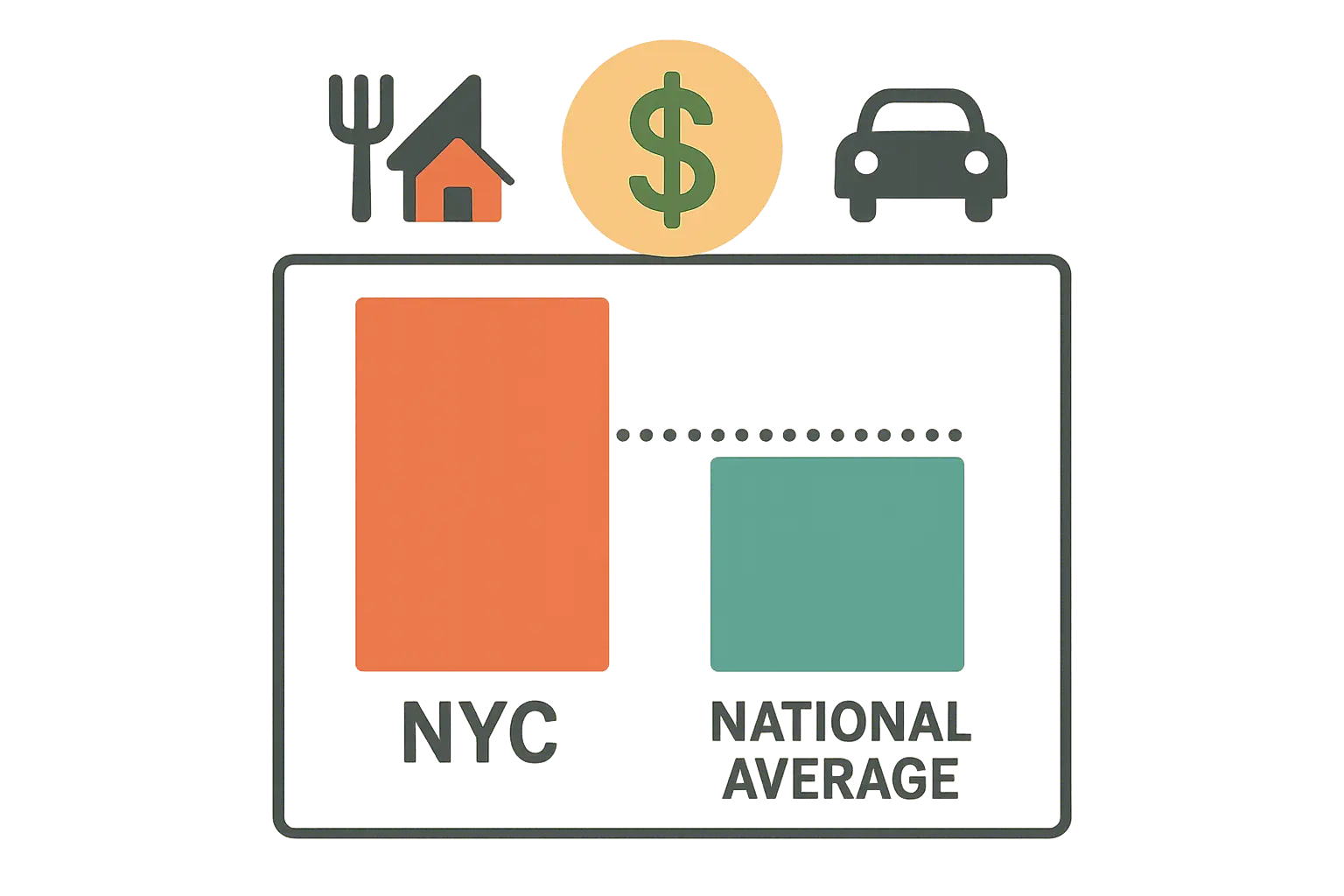
Let's be honest about what these salaries actually buy you. A $130K salary in NYC has about the same purchasing power as $90K in most other markets. Housing alone will eat up 30-40% of your income if you want to live anywhere decent.
But here's the thing – the career opportunities and networking potential in NYC often justify the higher costs, especially early in your career. The experience and connections you build here create opportunities that extend far beyond any single paycheck.
For healthcare professionals starting their careers, exploring affordable neighborhoods in NYC can help maximize your purchasing power while maintaining reasonable commute times to major medical centers.
Transportation, food, and entertainment costs are all significantly higher than national averages. Factor these into your financial planning. However, the career opportunities and earning potential in NYC often justify the higher costs, especially early in your career.
NYC's concentration of medical institutions creates networking opportunities that simply don't exist in other markets. The relationships you build here can benefit your entire career. Research opportunities abound in NYC's academic medical centers. Publications and research experience can open doors to consulting opportunities and speaking engagements.
The continuing education opportunities available in NYC are unmatched. You can attend world-class conferences and workshops without leaving the city. This professional development directly impacts your pa salary in ny potential over time.

NYC's population is aging rapidly, and this trend is creating unprecedented demand for healthcare services. Geriatrics and chronic disease management are becoming the fastest-growing areas of healthcare need.
This demographic shift means job security for PAs willing to develop expertise in age-related healthcare. Specializations in diabetes management, cardiovascular care, and geriatric medicine are becoming increasingly valuable. Healthcare policy changes and expanded access initiatives are amplifying this demand. The next 5-10 years will likely see continued upward pressure on physician assistant salary in new york as supply struggles to meet growing demand.
The healthcare landscape is changing rapidly. Telehealth, AI-assisted diagnostics, value-based care – these aren't future trends, they're happening now. The PAs who embrace these changes and develop expertise in emerging areas will command premium compensation.
Technology isn't replacing PAs - it's enhancing what we can do. Those who embrace AI-assisted diagnostics, telehealth platforms, and electronic health record optimization will command premium compensation. Telehealth expertise has become particularly valuable post-pandemic. PAs who can effectively deliver remote care often earn $60-$100 per hour for telehealth consultations, providing flexible income opportunities.
Healthcare delivery models are evolving rapidly, and PAs who stay ahead of these changes will reap the financial benefits. Value-based care, population health management, and preventive medicine are becoming central to healthcare strategy.
Entrepreneurial opportunities are expanding for experienced PAs. Consulting work, healthcare technology ventures, and specialized service delivery models offer paths to significantly higher earnings. For healthcare professionals considering their housing needs while building their careers, exploring communal living spaces in NYC can provide both affordability and networking opportunities with other ambitious professionals.
The key is maintaining flexibility and continuously developing new skills. The PAs who thrive in NYC's evolving healthcare landscape will be those who view change as opportunity rather than threat.
Future-Proofing Career Development Template:
NYC's PA salary landscape represents both tremendous opportunity and significant challenge. The financial rewards are substantial, but they require strategic thinking and careful planning to maximize.
Your success in this market depends on more than just clinical skills. Specialization, negotiation ability, and long-term career planning all play crucial roles in determining your earning potential. The PAs who thrive here are those who approach their careers with the same analytical thinking they apply to patient care.
Stay flexible, keep learning, and don't get too comfortable in any one role. The market rewards adaptability and continuous growth.
The investment in building a career in NYC's healthcare market pays dividends throughout your professional life. The experience, connections, and expertise you develop here create opportunities that extend far beyond any single position or physician assistant salary figure. Whether you stay in NYC long-term or eventually move to other markets, the foundation you build here will serve you throughout your career. Just make sure you don't lose yourself in the process.

Household supplies can be changed or decreaased at Outpost Club’s discretion, or based on supply availability. Outpost is not responsible for temporary losses of utility service. Outpost Club is not responsible for any damages due to absence of any supplies or utilities


If you have a sales related question please call
680-688-7678

 Hot Deals