$100K Salary After Taxes NYC: What You'll Really Take Home (And Why It Matters)
Jan 9, 2026
Jan 9, 2026
I'll never forget opening my first $100K paycheck in NYC. I was so excited—finally hitting six figures! Then I saw the actual number deposited into my account and literally said "Wait, where's the rest of it?" out loud to my laptop screen. After getting hit with federal, state, and local taxes, your actual take-home pay drops to approximately $66,000-$72,000 annually. According to recent data from Talent.com's tax calculator, if you make $100,000 a year living in New York, you will be taxed $28,124, leaving you with a net pay of $71,876 per year—a 28.1% average tax rate that basically means you're working until May just to pay the government.
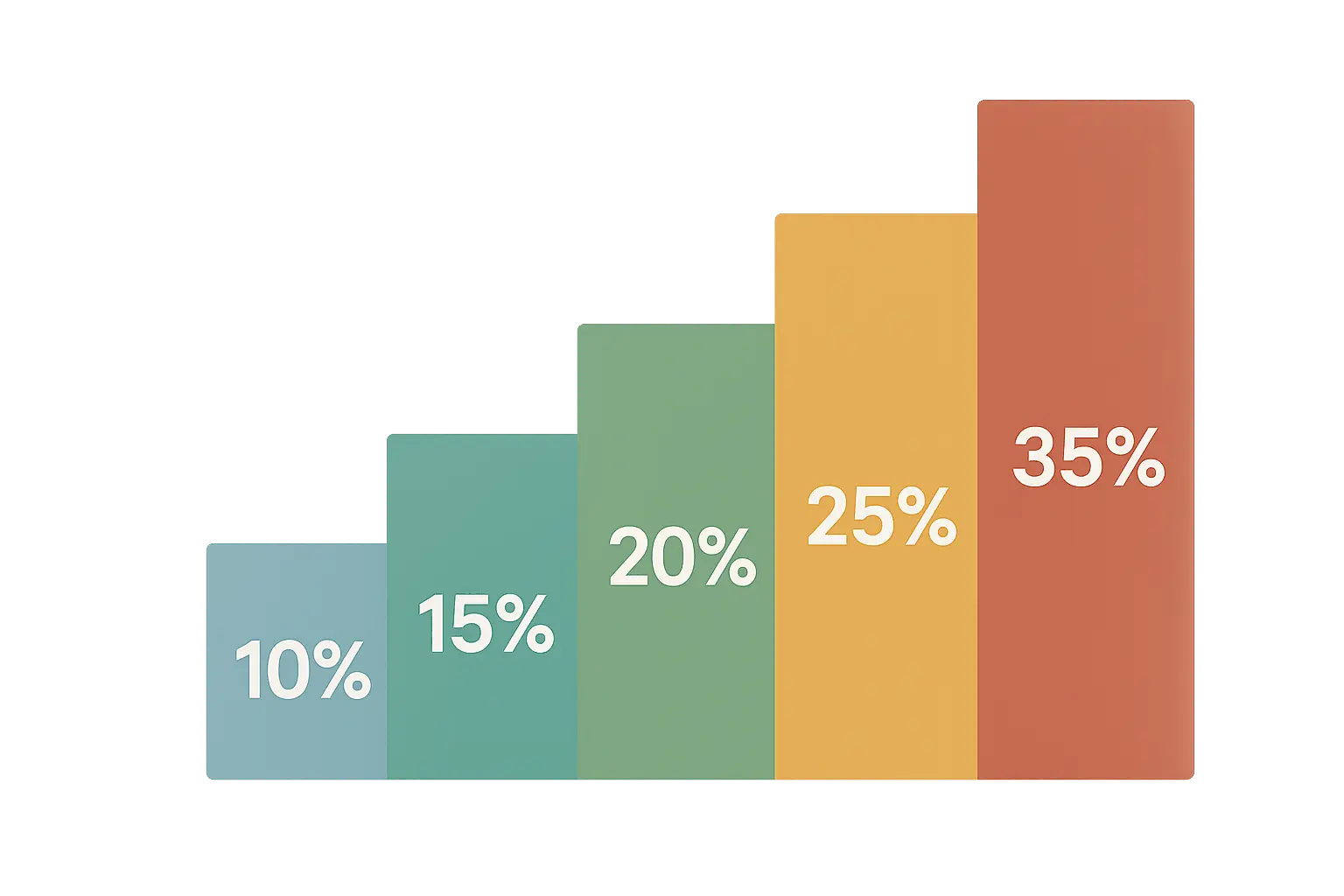
Okay, let's talk about how Uncle Sam takes his cut from your $100K. The whole "progressive tax system" thing sounds fancy, but here's what it actually means for your wallet: your first chunk of money gets taxed at 10%, then 12%, and finally 22% on the top portion. It's like a really unfair game where the more you make, the bigger bite they take.
I used to think I'd be paying 22% on everything—wrong! Your effective rate ends up around 12-15% depending on whether you're single or married. But honestly, before you get too excited about that "low" rate, remember we're just getting started with the tax parade.
Using a reliable new york paycheck calculator helps you see exactly how these brackets mess with your specific situation. Trust me, the math gets weird when you're dealing with federal, state, AND city taxes all at once.
Here's some good news in this sea of tax misery—the standard deduction is like an automatic shield. If you're single, they knock $14,600 off your taxable income before they even start calculating. Married couples filing jointly get $29,200.
So really, you're only paying federal taxes on $85,400 if you're single, not the full $100K. It's not much, but hey, we'll take any wins we can get in this tax nightmare.
And here's where it gets really fun (and by fun, I mean soul-crushing). Social Security and Medicare taxes don't care about your deductions, your feelings, or your rent situation. They just take 7.65% of your entire $100K salary. Period. End of discussion.
According to SmartAsset's New York paycheck calculator, FICA taxes are Social Security and Medicare taxes, withheld at rates of 6.2% and 1.45% of your salary, respectively. That's $6,200 for Social Security and $1,450 for Medicare—$7,650 total that just vanishes from your paycheck. No negotiating, no clever accounting tricks, just gone. It's like that friend who always "borrows" money but never pays you back, except it's the government and it's legal.
Just when you thought federal taxes were enough, New York State shows up like "Hold my beer." They've got their own progressive system running from 4% up to 10.9% for the really high earners. Your $100K salary usually gets hit with about 5.5-6.5% effective rate.
According to SmartAsset, New York state has a progressive income tax system with rates ranging from 4% to 10.9% depending on a taxpayer's income level and filing status. And yes, this stacks on top of federal taxes. Because apparently one government taking your money isn't enough—we need multiple levels getting their hands in your pockets.
Here's what really gets me: New York taxes pretty much everything as regular income. Side hustle money? Taxed. Investment gains? Taxed. That bonus you worked overtime for? Also taxed at the same brutal rates.
Other states might give you breaks on certain types of income, but not New York. They're like that teacher who never curves the test—no mercy, no exceptions.
Plot twist! Just when you think you've accounted for federal and state taxes, New York City slides in with their own income tax. We're talking another 3.078% to 3.876% depending on your situation.
I can't tell you how many people I know who budgeted for two tax hits and then got blindsided by this third one. It's like ordering a burger and finding out they charge separately for the bun, the meat, AND the cheese.
According to SmartAsset, NYC's local tax rates are progressive and based on income level and filing status, with four tax brackets starting at 3.078% on taxable income up to $12,000 for single filers, with the top rate for individual taxpayers being 3.876% on income over $50,000.
That "small" city tax? It's actually $3,000-$3,800 annually on your $100K. That's literally rent money just disappearing into the city's budget. And here's the kicker—you can't even fully deduct it on your federal return because of SALT limitations.
So you're getting taxed on money you used to pay taxes. It's taxation inception, and it's absolutely ridiculous.
Alright, let's rip the band-aid off. After federal taxes (~$12,000-15,000), New York State taxes (~$5,500-6,500), NYC taxes (~$3,000-3,800), and those unavoidable FICA taxes ($7,650), you're looking at taking home somewhere between $66,000 to $72,000.
That means roughly 28-34% of your salary just evaporates. Poof. Gone. It's like working until May just to pay your taxes.
Running these numbers through any decent tax calculator new york will show you the brutal reality. For context on whether this salary even makes sense, check out our breakdown of average salary expectations in NYC for some perspective on career planning.
|
Tax Type |
Annual Amount |
What This Actually Means |
|
Federal Income Tax |
$12,000-$15,000 |
There goes your vacation fund |
|
NY State Tax |
$5,500-$6,500 |
Goodbye, emergency savings |
|
NYC Municipal Tax |
$3,000-$3,800 |
Your monthly MetroCard for the year |
|
FICA |
$7,650 |
That gym membership you can't afford |
|
Total Stolen |
$28,150-$32,950 |
Almost a third of your life |
|
What You Actually Get |
$67,050-$71,850 |
Reality check time |
Recent analysis from "Empower" shows that typical monthly rent in New York City is $3,596, which represents 43.2% of gross income on a $100K salary. Yeah, that math doesn't work.
Your monthly take-home sits between $5,500-$6,000. Financial experts love to say "keep housing below 30% of take-home pay," which gives you a whopping $1,650-1,800 for rent.
Good luck finding anything decent in Manhattan for that. I'm talking about places where you can actually stand up straight and don't share a bathroom with three strangers.
Most people I know earning $100K end up spending 40-50% on housing because the alternative is living in someone's converted garage in Queens with a 90-minute commute each way. For those looking for more realistic options, shared apartments in New York often become the only viable solution.
Sarah's Reality Check: Sarah, a marketing manager earning $100K, discovered her monthly take-home of $5,750 meant her ideal rent budget of $1,725 (30% rule) eliminated literally every decent Manhattan studio. She eventually found a shared two-bedroom in Astoria for $1,600 monthly, requiring a 45-minute commute but letting her actually save money instead of being rent-poor.
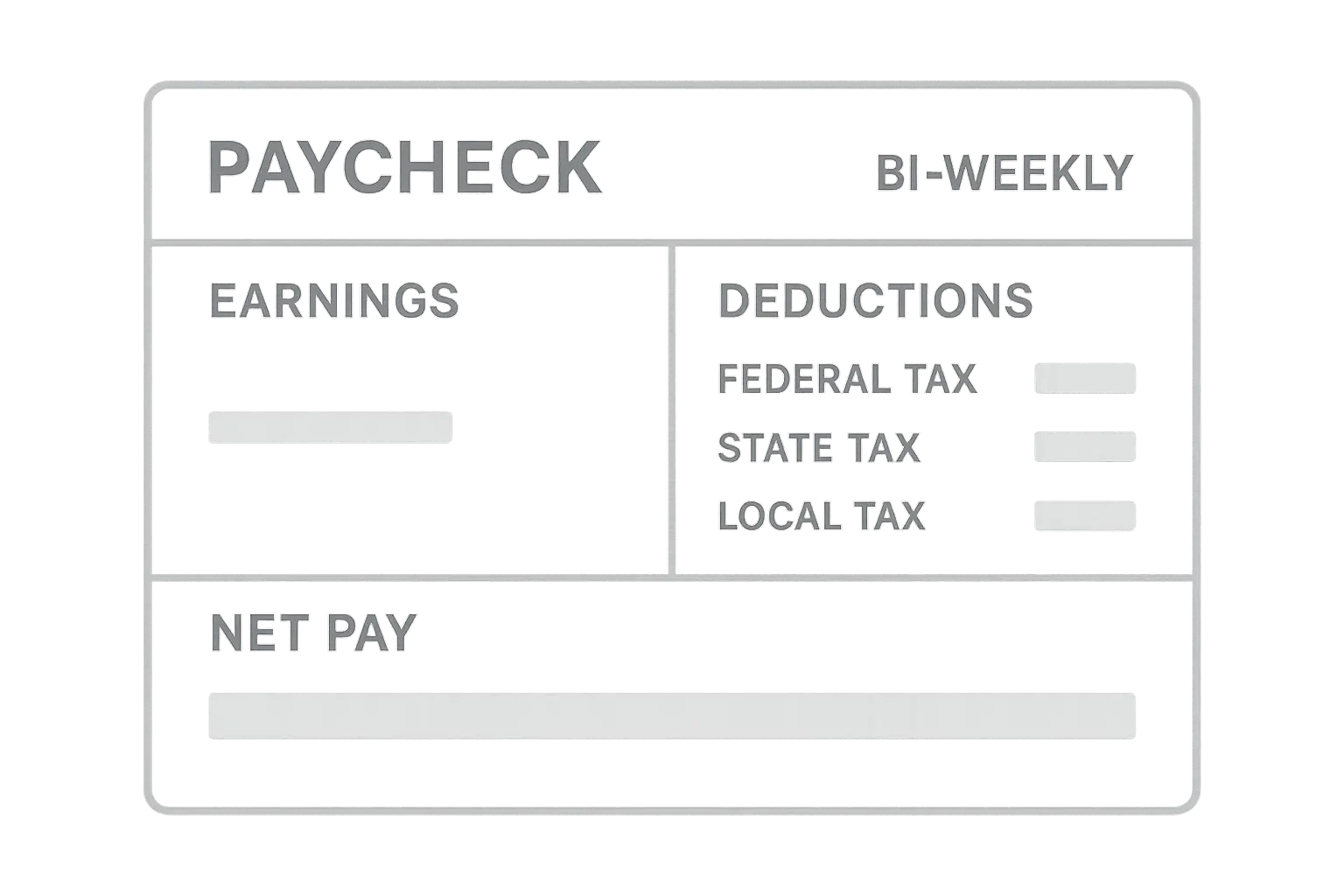
Most companies pay every two weeks, so you're looking at individual paychecks between $2,540-$2,770. This is crucial info for your mental health—seeing that number hit your account twice a month instead of a big monthly chunk somehow makes it feel less devastating.
Just remember, this fluctuates based on your health insurance, 401(k) contributions, and whether you're smart enough to max out those pre-tax benefits (spoiler alert: you should be).
Here's where you can fight back against the tax machine. Every dollar you put into pre-tax deductions is a dollar that avoids federal, state, AND city taxes. We're talking about a triple win here.
Max out that 401(k) at $23,000? You could save roughly $7,000-8,000 in combined taxes. That's real money back in your pocket. HSAs are even better if you qualify—tax-free going in, tax-free coming out for medical expenses.
Use any decent new york paycheck calculator to model different contribution scenarios and watch your take-home pay improve immediately. It's like finding a legal loophole that actually works in your favor for once.
Mike's Tax Optimization Win: Mike increased his 401(k) contribution from $6,000 to $20,000 annually, reducing his taxable income and saving approximately $6,800 in combined federal, state, and city taxes. This strategy effectively gave him a 34% immediate return on his additional retirement savings. Not bad for just checking different boxes on his payroll forms.
Your Pre-Tax Battle Plan:
If your employer offers health insurance, those premiums come out pre-tax. This is basically free money—well, free tax savings anyway. Marketplace insurance uses after-tax dollars, so employer plans are usually the way to go even if they're not perfect.
The pre-tax advantage makes employer plans way more valuable than the sticker price suggests, giving you tax relief across all three jurisdictions.
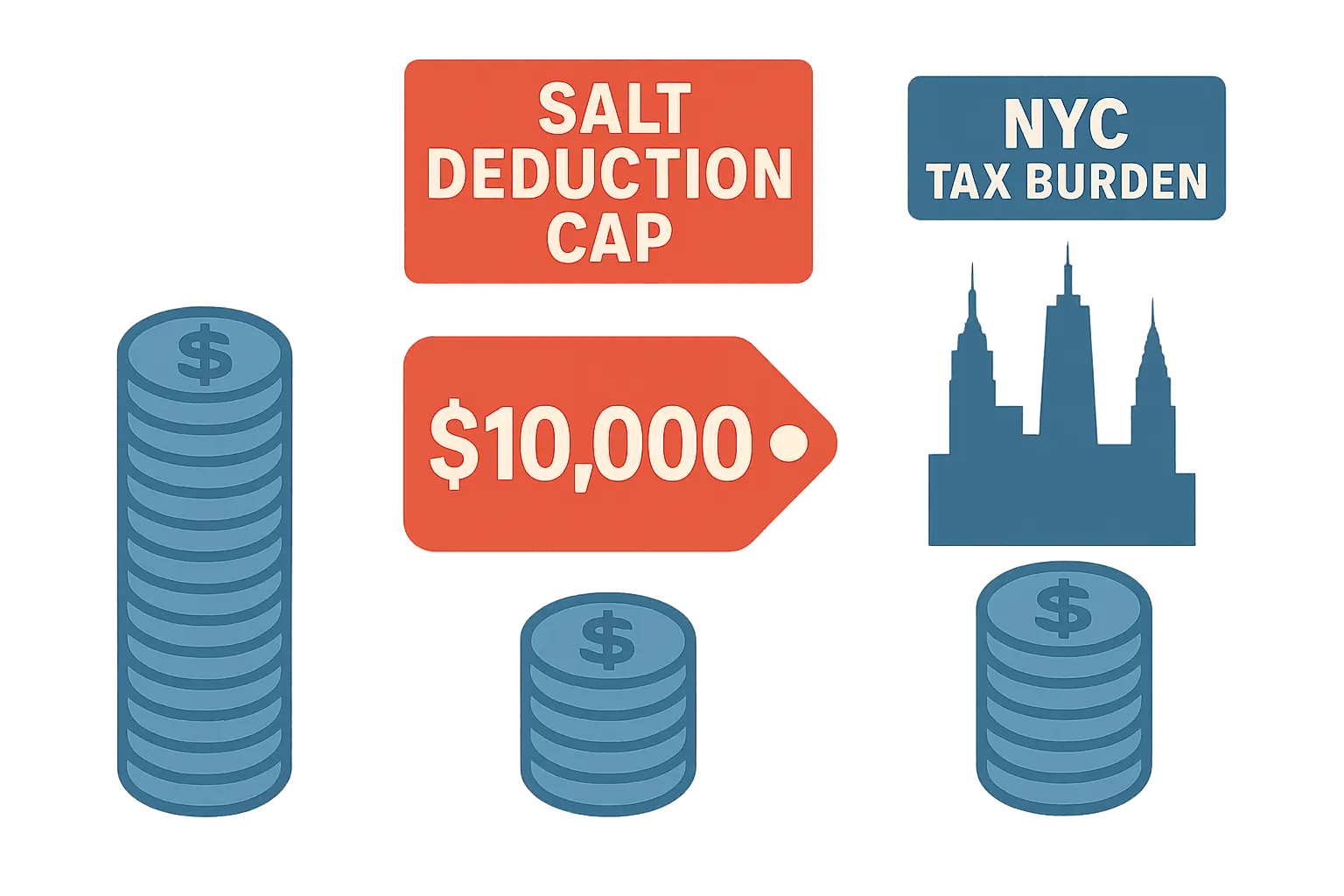
This one makes me genuinely angry. The federal government caps your state and local tax deductions at $10,000. Meanwhile, you're paying way more than that just in state and city taxes alone
So you're paying taxes on money you used to pay taxes. It's like being charged a fee for paying a fee. This creates effective double taxation that residents of no-tax states don't have to deal with. Absolutely infuriating.
Not all paycheck calculators are created equal. You need one that specifically accounts for NYC's triple-tax nightmare. If it doesn't include city taxes, it's basically useless and will give you false hope about your take-home pay.
Look for calculators that let you input your filing status, pre-tax deductions, and actually break down where every dollar goes. Knowledge is power, even when that knowledge is depressing.
A comprehensive nyc paycheck calculator should provide detailed breakdowns showing exactly where every dollar goes. For broader context on what these numbers mean for your overall financial picture, our guide on NYC salary calculations and hidden costs breaks down all the financial realities you need to consider.
Calculator Checklist (Don't Skip These):
December is your friend for tax optimization. You can still max out retirement contributions, time bonus payments strategically, or bunch deductions. That full $23,000 401(k) contribution provides immediate relief across all three tax jurisdictions.
Basically, anything you can do to reduce your taxable income before December 31st is money in your pocket. Strategic year-end planning can literally save you thousands.
Got a side hustle? Freelance work? Congrats, you now get to pay taxes four times a year instead of just having them taken out of your paycheck. NYC's brutal tax combo makes this especially important because owing money to three different governments gets expensive fast.
Calculate carefully using a detailed new york paycheck calculator to estimate your quarterly obligations. Trust me, you don't want to owe significant amounts to federal, state, AND city tax authorities all at once.
Here's another fun fact: capital gains get preferential treatment federally but New York and NYC tax them as regular income. So that stock you held for over a year? The feds might tax it at 15%, but New York treats it like regular salary income.
This makes tax-loss harvesting way more valuable for us city folks. Every little bit of tax optimization helps when you're getting hit from three directions.
Traditional 401(k) contributions give you immediate tax relief from all three tax jurisdictions. Roth contributions don't help now but grow tax-free forever.
Given how brutal NYC taxes are right now, traditional contributions usually make more sense if you're planning to retire somewhere with lower taxes (which, let's be honest, is pretty much anywhere else).
Let's do some painful math. With $66K-72K take-home, the famous "30% rule" gives you $1,650-1,800 for rent. In Manhattan, that might get you a closet with a window if you're lucky.
The math just doesn't work for solo living in decent areas. Period. Most people end up with roommates, longer commutes, or spending way more than 30% on housing because the alternatives are worse.
According to a recent "Fox5NY study", Manhattan, New York had the least value for $100K, with only $30,362 in spending power, while the study found that after accounting for federal taxes, particularly high local taxes, and a cost of living 130.6% higher than the national average, a $100k salary goes least far in New York City.
|
NYC Borough |
Median Rent (1BR) |
% of Take-Home ($5,750) |
Feasible on 30% Rule? |
|
Manhattan |
$3,200-$4,500 |
56-78% |
❌ Absolutely not |
|
Brooklyn (Prime) |
$2,800-$3,500 |
49-61% |
❌ Still no |
|
Brooklyn (Outer) |
$1,800-$2,400 |
31-42% |
⚠️ Maybe with ramen diet |
|
Queens |
$1,600-$2,200 |
28-38% |
✅ Your best bet |
|
Bronx |
$1,400-$1,900 |
24-33% |
✅ Doable but commute |
Many professionals earning $100K find that shared apartments in New York become the most viable option for maintaining both financial health and quality of life within their budget constraints.
Here's one bright spot: that $132 monthly MetroCard actually saves you money. Car ownership in NYC easily costs $500-800 monthly between insurance, parking, and the constant stress of alternate side parking.
Going car-free is basically mandatory on this salary, but it's actually a financial win compared to suburban life. No car payments, no insurance, no gas, no parking tickets that make you question your life choices.

Financial experts say 3-6 months of expenses in emergency savings. In NYC, that's $15,000-25,000. Yes, you read that right. That's like saving an entire year's worth of rent just for emergencies.
Start small and build up. Even $1,000 is better than nothing, and you can grow from there without feeling overwhelmed.
Jessica's Emergency Fund Strategy: Jessica automated $400 monthly transfers to a high-yield savings account, building her $20,000 emergency fund over four years. She started with a $1,000 goal, then increased to $5,000, making the larger target feel achievable through incremental milestones.
The magic number is 20% of your take-home for savings. That's roughly $13,200-14,400 annually, which sounds impossible when you're already stretching every dollar.
Start with whatever you can manage—even 5% is progress. You can increase it with raises, bonuses, or when you finally escape the roommate situation.
A 20% savings rate on a $100K NYC salary requires setting aside substantial portions of available income. Many professionals find success by exploring practical strategies from our guide on the real cost of living in NYC to identify areas where they can optimize spending without sacrificing quality of life.
20% Savings Game Plan:
Here's something nobody tells you: salary increases in NYC have diminishing returns because of marginal tax rates. That $10K raise might only net you $6,500-7,000 after all the tax hits.
Factor this into negotiations. Sometimes benefits, flexible work arrangements, or professional development opportunities are worth more than the salary bump.
A lot of NYC professionals eventually escape to lower-tax states while keeping their jobs remote. But be careful—New York has "convenience of employer" rules that might still require you to pay NYC taxes even if you move.
Research this carefully before making any moves. The tax savings might not be as big as you think if New York decides you're still working for their convenience.
Look, living on $100K in NYC requires creativity and strategic thinking. You're probably going to spend 40-50% on housing, which leaves limited room for everything else.
But here's the thing—people do it successfully. They just have to be really smart about priorities and trade-offs. Maybe that means roommates in a great neighborhood instead of a studio in a mediocre one. Maybe it means cooking at home more and going out less.
For those seeking more practical housing solutions that free up budget for lifestyle experiences, consider exploring furnished rooms for rent that eliminate the upfront costs of furnishing while providing community connections.
The key is being honest about the constraints while still finding ways to enjoy what makes NYC amazing. Because despite all these financial headaches, there's still something special about this crazy expensive city.

Your $100K NYC salary turning into $66K-72K take-home isn't just a number—it's your new reality that affects every financial decision you'll make. The triple tax hit from federal, state, and city governments is brutal, and anyone who tells you otherwise is either lying or doesn't live here.
But knowledge is power. Understanding exactly where your money goes helps you make better decisions about everything from apartment hunting to career planning. Yes, the math is depressing, but at least now you know what you're dealing with.
The secret to making it work is maximizing every tax advantage you can get, being realistic about housing costs, and building toward future flexibility. Whether that means aggressive 401(k) contributions, strategic career moves, or eventually planning your escape to a lower-tax state, it all starts with understanding your true financial picture.
Bottom line: $100K in NYC is definitely doable, but it requires a level of financial discipline and strategic thinking that you might not need elsewhere. The good news? If you can make it work here, you can probably make anything work anywhere else.
A $100K NYC salary's transformation to $66K-72K take-home requires strategic financial planning and realistic expectations about living costs and lifestyle constraints. Success depends on maximizing pre-tax deductions, building adequate emergency funds, making informed housing decisions, and planning for long-term financial flexibility while understanding the true value of after-tax dollars in one of America's most expensive cities.

Household supplies can be changed or decreaased at Outpost Club’s discretion, or based on supply availability. Outpost is not responsible for temporary losses of utility service. Outpost Club is not responsible for any damages due to absence of any supplies or utilities


If you have a sales related question please call
680-688-7678

 Hot Deals