NYC Cop Salary: What Every Future Officer Needs to Know About NYPD Pay
Jan 5, 2026

Jan 5, 2026
Police officers and sheriff's patrol officers earn a median annual salary of "$76,290" All Criminal Justice Schools, though NYPD compensation follows a unique structure that can lead to significantly higher earnings through overtime and specialized assignments. Look, if you're thinking about becoming a cop in NYC, you need to know what you're really getting into financially - the full picture isn't just about that base salary number.
Here's the deal with NYPD pay - it actually follows a pretty straightforward system that shows you exactly where your paycheck is headed over the years. The NYPD doesn't mess around with confusing pay scales or mysterious bonus structures. They lay it all out for you: stick around, do your job, and your salary climbs predictably. The thing is, don't just look at that starting salary and panic. You've got to see the bigger picture of where this career can take you money-wise.
Let me be straight with you - becoming an NYPD officer means you're basically starting from scratch financially, but at least you're getting paid while you learn the ropes. Those first few months at the academy? Yeah, you're not getting rich, but you're also not working some dead-end job while trying to figure out your life. Many people wonder how much does a police officer make during training, and honestly, it's enough to survive but not much more.
During your six months at the Police Academy, you'll pull in about $42,819 a year - that's roughly $3,568 a month. It's not champagne money, but hey, you're getting paid to train for a career that could set you up for life.
Here's the reality check: this academy pay isn't meant to fund some fancy Manhattan lifestyle. You're looking at basic survival mode here. Most recruits I know were splitting apartments in Queens, taking the subway everywhere, and cooking at home way more than they'd like to admit.
Take my buddy Mike from the academy. He was splitting a cramped Queens apartment with his cousin, and even with roommate help, that $3,568 monthly check barely covered the basics. His $1,200 rent share, $400 in subway and food costs, $600 for groceries, and $300 for everything else left him with about $1,000 for savings if he was lucky. He was eating a lot of ramen those first six months, but at least he was getting paid to learn.
Graduation day? That's when things start looking up. You're looking at $47,000-$50,000 to start - not exactly "quit your day job" money in NYC, but it's a real step up from academy pay. Plus, now you've got actual benefits kicking in. The nypd starting salary marks the beginning of what could be serious earning potential down the road.
Look, $47K in NYC? You're not exactly living large, but it's a start. The real kicker is knowing that this is just the bottom rung of a ladder that goes way, way up if you stick with it.
Here's where it gets interesting. The NYPD salary progression isn't some mystery - they lay it all out for you. Stick around, do your job, and your paycheck grows. It's not rocket science, but it does require patience. Understanding how much does a police officer make at each stage helps you plan for major life decisions.
|
Years of Service |
Base Salary Range |
Total with Overtime |
What This Really Means |
|
Academy (6 months) |
$42,819 |
$42,819 |
Ramen noodle phase |
|
Year 1 |
$47,000-$50,000 |
$55,000-$70,000 |
Still tight, but breathing room |
|
Years 2-3 |
$60,000-$70,000 |
$75,000-$95,000 |
Starting to feel human |
|
Years 4-5 |
$80,000-$90,000 |
$100,000-$125,000 |
Now we're talking |
|
Years 6-10 |
$100,000-$120,000 |
$130,000-$170,000 |
Solid middle class |
|
10+ Years |
$130,000-$140,000 |
$160,000-$200,000+ |
Top of the food chain |
Your first five years? That's where the magic happens. You go from scraping by on $47K to pulling in close to $90K. We're talking about almost doubling your income in five years - show me another job that does that without requiring you to go back to school.
Each step up brings real changes to your life. By year three, you're not just surviving in NYC anymore - you're actually living here. Year five? That's when most cops I know stop stressing about every grocery bill and start thinking about maybe getting their own place without roommates. For those researching how much does a police officer make in their early career, this rapid climb shows why sticking with the department pays off.

Once you hit that 5-10 year mark, you're looking at $85K-$130K annually. Your exact spot in that range depends on how much overtime you want to work and whether you get into any special assignments. This is where a lot of cops find their groove - decent money, know the job inside and out, and can actually plan for the future.
This is when you can start making real life decisions - buying a place, starting a family, or maybe even taking a vacation that doesn't involve camping in your cousin's backyard.
Top pay hits around $130K-$140K after 10+ years. That's your baseline before you factor in overtime, court time, or any special details. Not bad for a job that doesn't require a college degree, right?
But here's the thing - reaching top pay doesn't mean you stop making more money. The guys pulling in $200K+ are working overtime like it's their second job.
Now, before you get too focused on just the salary numbers, let me tell you about the stuff that doesn't show up on your paycheck but is worth serious money. We're talking benefits that would cost you a fortune if you had to pay for them yourself.
However, let's be real about overtime - recent federal investigations into overtime abuse have shown that while the opportunities are there, you've got to earn them legitimately. "Federal prosecutors are now investigating former NYPD Chief of Department Jeffrey Maddrey" ABC7NY, over some sketchy overtime practices, so don't think you can game the system.
The benefits package is where the NYPD really shines compared to most jobs. We're talking about healthcare and retirement benefits that are worth tens of thousands of dollars a year - money you'd have to shell out of your own pocket at most other jobs.
Full family health coverage - medical, dental, vision, the works. The city picks up most of the tab, which can save you $15K-$25K a year easy if you've got a family. That's real money that stays in your pocket instead of going to some insurance company.
And it's not some garbage high-deductible plan either. When your kid breaks their arm or your spouse needs surgery, you're not sitting there doing math on whether you can afford to get them help.

Here's the golden handcuffs part - stick around for 20 years and you can retire with a pension that's about half your final salary. For life. An officer retiring at top pay could be looking at $65K-$70K a year for the rest of their life, starting potentially in their early 40s.
Think about that for a second. You could be done with the NYPD at 42 and collecting a $70K pension while you start a second career. The value of these pensions is substantial - "Two New York Police Department retirees each collected total retirement benefits of more than $600,000 last year" Empire Center. That's not chump change.
This is where things get interesting - if you don't mind working your butt off. Overtime at time-and-a-half can seriously boost your take-home pay. We're talking $20K-$50K+ extra per year if you're willing to put in the hours.
Let's do the math. You're making $85K base ($40.87 an hour), overtime pays $61.31 per hour. Work just 10 extra hours a week and you're adding over $31K to your annual income. Some guys I know are working way more than that.
Take Officer James Chen - five-year vet making $85K base. He worked Times Square detail during the holidays, pulling 15 hours of overtime weekly. That extra $47K brought his total to $132K for the year. Not bad, but he was basically living at work.
Court appearances, construction details, special events - these can pay even better than regular overtime. Some details pay $50-$75+ per hour. Court time is especially nice because when you get subpoenaed, that's mandatory overtime right there.
The busy cops with multiple court cases can rack up serious overtime just showing up to testify. It's not glamorous, but it pays the bills.
Now here's where we need to have a reality check. Yeah, NYPD salaries look pretty good on paper, but this is New York City we're talking about. Everything costs more here - and I mean everything. Just like our guide on the real cost of living in NYC shows, there are hidden expenses that'll catch you off guard.
Living in NYC on a cop's salary requires some serious financial planning and realistic expectations. Don't expect to be living in some Manhattan penthouse on a first-year officer's pay. It's just not happening.

Rent in NYC is brutal - we're talking $3K-$4K a month for decent places. That means housing could eat up 40-60% of your income, especially when you're starting out. A first-year officer making $47K is going to struggle in most neighborhoods.
Most cops I know either live way out in Queens or the Bronx, or they're splitting places with roommates well into their careers. It's not ideal, but it's reality until your salary catches up to the cost of living. Many officers explore shared apartments in New York to manage housing costs while building their careers.
That $15 lunch, $132 monthly MetroCard, parking that costs more than some people's rent - it all adds up fast. You'll spend more on daily expenses here than you would almost anywhere else in the country.
But here's the thing - cops get discounts at a lot of places, and there are ways to make it work. You just have to be smart about it and not try to live like you're making Wall Street money when you're not.
Real Talk: Managing NYC Costs as a Cop
Look, there are other options out there that might pay better upfront, but few give you the job security and pension that comes with being a cop. Understanding how much does a police officer make compared to other careers helps put things in perspective.
Corporate security might start you at $60K-$80K, but good luck finding the benefits and pension security you get with the NYPD. Private investigation can be lucrative if you're good at it - some guys make $75-$150 an hour - but that's feast or famine work, not steady income.
The bottom line? Private sector might pay more upfront, but it lacks the long-term security and benefits that make police work attractive for building a career.
Here's something most people don't realize - there are other law enforcement agencies in the area that sometimes pay better than the NYPD. It's worth knowing your options. Similar to how average salary in NYC varies across different fields, law enforcement pay differs dramatically between agencies.

Not all cops in NYC work for the NYPD, and some of these other agencies have better pay scales.
Port Authority Police often start around $50K-$55K and can hit $120K+ faster than NYPD officers. They handle airports, bridges, tunnels - different work, but often better pay progression.
The catch? It's not street policing. You're dealing with transportation security and infrastructure protection. Some cops love it, others find it boring compared to traditional police work.
Data shows that among Long Island police departments, which compete for similar candidates, "The 24,400 police/fire employees were paid an average of $123,040" Empire Center, which gives you an idea of what the competition looks like around here.
FBI, DEA, other federal agencies - they use the GS pay scale and can exceed NYPD pay over time. FBI special agents might start around $52K-$67K but can advance to $95K-$140K+ with federal benefits.
Different work though - you're looking at federal crimes, terrorism, interstate stuff. Not everyone's cup of tea, but the advancement potential can be better.
Nassau and Suffolk County departments often start officers at $60K-$70K with faster paths to $150K+. Sounds great, right?
Well, you're also dealing with suburban policing, which can be boring as hell compared to NYC. Plus, many have residency requirements, so you're stuck living where you work. When considering how much does a police officer make in suburban departments, you've got to factor in the lower living costs but also the different work environment.
|
Agency Type |
Starting Pay |
Max Pay |
The Reality |
|
NYPD |
$47K-$50K |
$130K-$140K |
Urban intensity, great benefits |
|
Nassau County |
$60K-$70K |
$150K+ |
Suburban, residency requirements |
|
Suffolk County |
$60K-$70K |
$150K+ |
Community-focused, less action |
|
Port Authority |
$50K-$55K |
$120K+ |
Transportation focus, different work |
|
Federal Agencies |
$52K-$67K |
$95K-$140K+ |
Specialized, nationwide mobility |
Nassau and Suffolk County departments serve more affluent communities with different crime patterns than NYC neighborhoods. The work environment is typically less intense than urban policing, but you might miss the variety and specialized opportunities that come with the NYPD's size.
However, these positions often have strict residency requirements and different promotional structures. You might make more money faster, but you're also limited in terms of career diversity and advancement options.

Here's the thing about NYPD pay - you don't negotiate individually. The union handles that for everyone, which has pros and cons.
The PBA (Police Benevolent Association) fights for salary increases and better benefits for all officers. When they win, everyone wins. When they don't, well, everyone waits.
The union has secured some solid wins lately. Recent contracts included retroactive pay increases - some officers got lump sums over $10K just from back pay. That's real money hitting your account.
When Officer Sarah Martinez's contract got settled in 2023, she got a $12,500 retroactive payment plus an $8K annual raise going forward. Not bad for something she didn't have to negotiate herself.
The union's pushing for retention bonuses, hazard pay adjustments, and tech allowances. With departments struggling to hire, there might be signing bonuses or educational incentives coming down the line.
The union continues fighting for improvements that reflect how challenging police work is and the competitive job market for qualified candidates. These efforts directly impact your future earning potential.

While you can't negotiate your base salary, there are ways to boost your earning potential.
College degree? That can get you faster promotions and access to specialized assignments that pay premiums. Some positions pay $5K-$15K extra annually just for having a degree.
Graduate degrees can open doors to federal task forces, specialized investigations, or administrative roles with better pay. The investment in education often pays dividends through faster advancement and access to higher-paying assignments.
Speak Spanish? Know computers? Have military experience? These skills can get you into specialized units or federal task forces with better pay and opportunities.
Cybercrime, financial investigations, counterterrorism - these specializations can lead to assignments that pay way above standard rates. Bilingual officers often get language premiums and access to specialized assignments that come with extra compensation.
Alright, so you're thinking about doing this. Here's what you're getting into with the application process. Just like moving to New York requires serious planning, becoming an NYPD officer involves navigating multiple requirements and procedures.
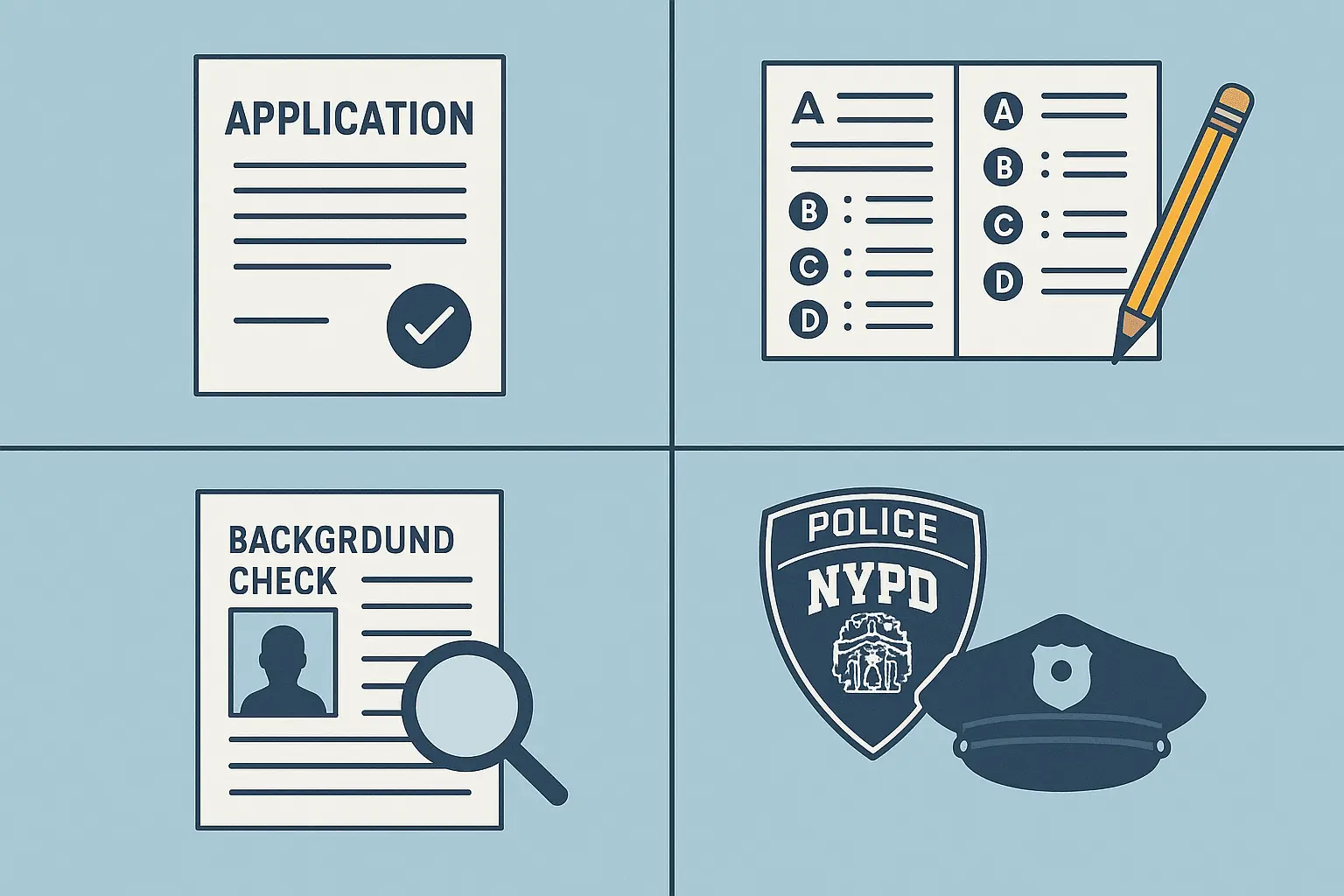
The NYPD application process is no joke. It's designed to weed out people who aren't serious about this career.
You need to be 21, have a high school diploma (college helps), be a U.S. citizen, and have a clean background. The age thing ensures you're mature enough for the responsibility, and the background check is thorough - they're going to dig into everything.
Real Talk: NYPD Application Checklist
Written exam, physical fitness, psychological evaluation, background investigation - this process can take months and each step eliminates people. The written test covers reading comprehension and situational judgment. The physical test will kick your butt if you're not in shape. The psych evaluation weeds out people who can't handle the stress of police work.
The background investigation is where they really dig deep. They'll talk to your neighbors, your ex-girlfriends, your high school teachers - everyone. If you've got skeletons in your closet, this is where they come out.
Once you're in, there are plenty of ways to advance and make more money. Career advancement works similarly to other NYC professions - just like understanding NYC teacher salary progression, NYPD officers benefit from strategic career planning.

Detective positions usually come with better schedules and often more pay. Specialized units like narcotics, counterterrorism, or cybercrime offer unique career paths and often better compensation.
Counterterrorism works with federal agencies on high-profile cases. Cybercrime investigates online offenses and financial crimes. Each specialty offers different challenges and advancement opportunities.
Sergeant, lieutenant, captain - each promotion comes with significant salary increases and leadership responsibilities. Top positions reach well into six figures and give you real influence over how the department operates.
But here's the thing about promotions - they're competitive as hell. You'll be taking exams, going through interviews, and competing with other officers who want the same spots. It's not automatic, but if you're willing to put in the work and play the politics game, the opportunities are there.
The supervisory track is where you can really max out your earning potential, but you're also trading street work for desk work and dealing with department bureaucracy. Some cops love the leadership aspect, others miss being out on patrol.
For NYPD officers looking for quality recreation and networking opportunities, we understand the unique pressures of law enforcement work. The demanding nature of police work requires healthy outlets for stress relief and relationship building outside the department.
Look, here's the bottom line on NYPD pay: it's not going to make you rich quick, but it can set you up for a solid middle-class life in one of the most expensive cities in America. The starting salary sucks, but if you stick with it, the money gets real.
The pension system is the golden handcuffs - 20 years and you're set for life with a steady check coming in. That's security most people in the private sector can only dream about. Yeah, you'll struggle those first few years, especially with NYC's crazy cost of living, but the guys who tough it out usually end up doing pretty well for themselves.
Is it worth it? Depends on what you're looking for. If you want to get rich fast, go work on Wall Street. If you want job security, decent pay that grows over time, great benefits, and the chance to retire young with a pension, then yeah, NYPD might be your ticket.
Just don't go into this thinking it's easy money. You'll earn every dollar, especially in those early years. But for guys who can handle the stress, the hours, and the bureaucracy, it's a career that can provide real financial security in a city where that's getting harder and harder to find.
The overtime is there if you want to work for it, the benefits are solid, and the pension is legit. Just remember - this isn't just a job, it's a lifestyle. Make sure you're ready for that before you sign up.

Household supplies can be changed or decreaased at Outpost Club’s discretion, or based on supply availability. Outpost is not responsible for temporary losses of utility service. Outpost Club is not responsible for any damages due to absence of any supplies or utilities


If you have a sales related question please call
680-688-7678

 Hot Deals